


“It is all about the Engines”
There will be no new generation narrowbody design from either of the ‘Big Two’ for a decade from now; largely due to engine OEMs nervousness and airlines being content with existing improvements.
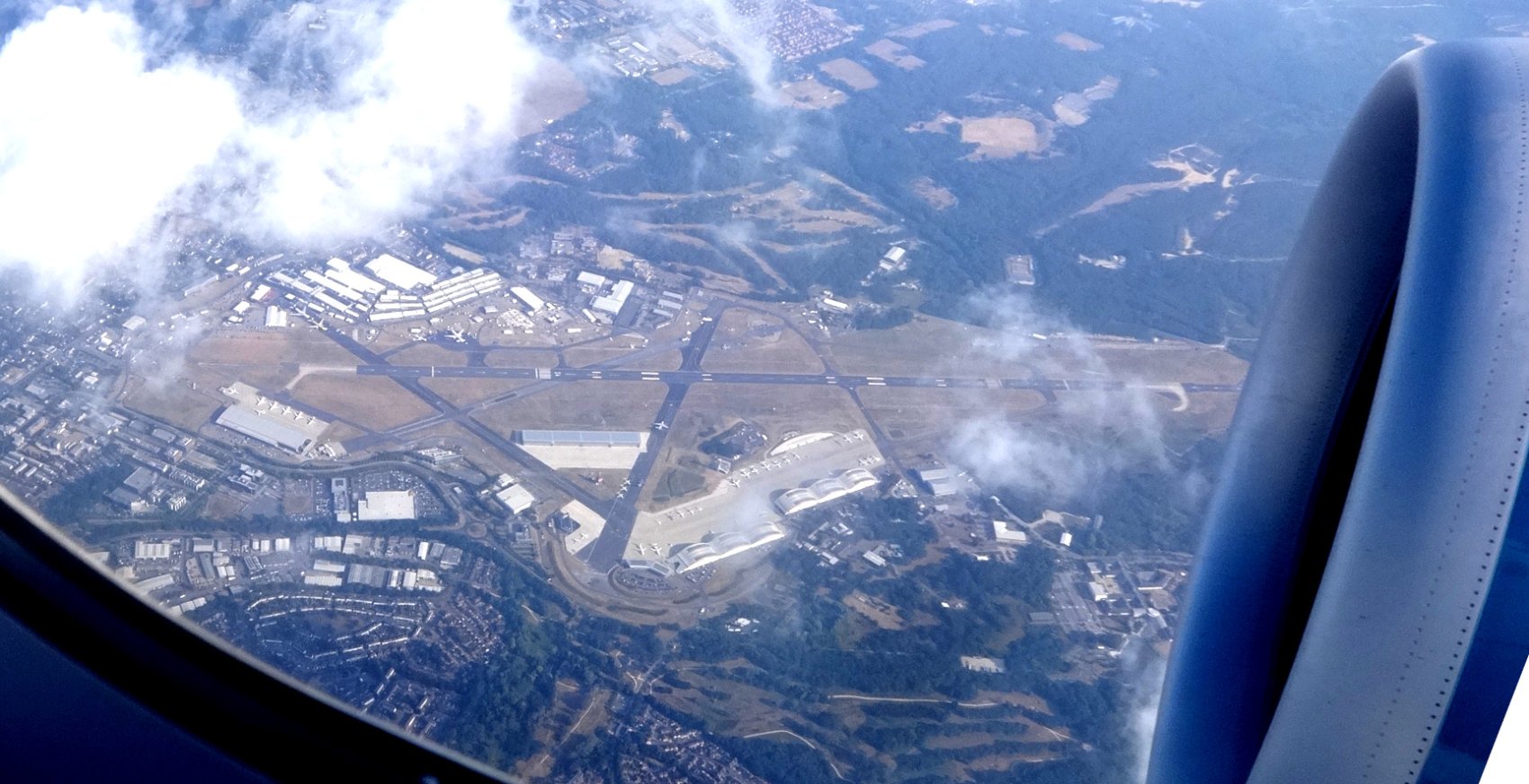
Since 2019 Farnborough’s core audience focus is for business and government. This year increased military spending commitments increased exhibitor numbers, with 23% first timers of a total of 1,600 and some hundred thousand visitors.
The civil airline sector is virtually in the opposite scenario with combined airlines net profit forecast to decline from $45 billion in 2025 to $23 billion this year and margins from 4.2% to 2% respectively.
As readers will expect, the War on Iran and their predictable retaliations, resulting in a crude oil shortage of around 15 million barrels a day, is the main driver for this decline, followed by production delays for new more fuel-efficient airliners, increased maintenance for the older ones continuing in service and elevated lease rates. As well as the high fuel cost increase, airspace disruptions (Gulf, Russia) and longer routings for European long-haul carriers weight heavily.
However, passenger demand and underlying willingness to travel remains robust and Pax traffic may still grow by 2% this year
Jet fuel price
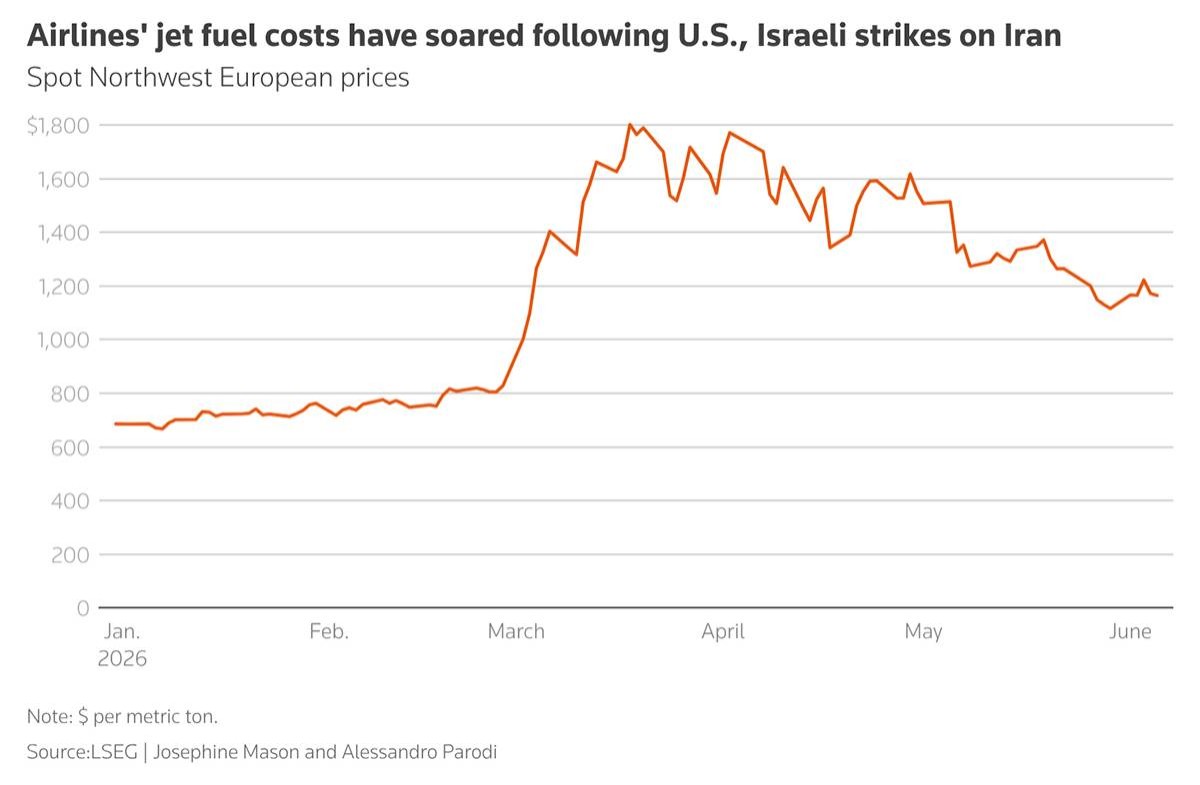
Jet A1 Kerosene had roughly doubled since late February, and as of mid March IATA were reporting $175 / 179 per barrel of Kerosene on average. Whilst this price has eased the continuing US-Iran impasse over the Strait of Hormuz will make jet fuel price uncertainty long lasting.
Jet fuel price is predicted to remain disproportionally high relative to crude through to next year 2027. The difference is known as the “Crack Spread” and is due to reduced refinery capacity plus supply chain bottlenecks, a ‘higher-for-longer’ scenario is playing out. Recovery to cheap JetA1 will take time
Across 61 European airports the rise in fuel book stock was 62% in April compared to April 2025. Airlines that have hedged fuel and have access to hubs deep storage facilities will get through the summer and autumn. Once the hedges run out the full market price of refined kerosene will hit.
According to S&P Global Energy JetA1 production is down some 16% but tradeable volumes down an estimated 46%. The dynamic is companies and governments are protecting their own fuel supply and not exporting, just-in-case the US/Iran stalemate continues.
Ryanair’s Michael O’Leary is more optimistic “Generally, across Europe, most JetA1 is supplied from Norway, West Africa and N America, so we are growing more confident there won’t be a fuel supply disruption”
Europe-Gulf hubs-Asia long haul traffic are clearly affected. In 2010 this was some 9 million Pax rising in 2025 to approxiately 27 million. Most of the big European carriers have reduced frequencies, suspended or cut numerous Asia routes. And this on top of closed Russian airspace.
The massive rise in the price of JetA1 was the final nail in the coffin for ultra low cost carrier Spirit Airlines on 2nd May; $4.5 per gallon jet fuel at the time; which had been struggling since last year.
Sustainable Aviation Fuel SAF
Long term investment is lacking and the physical supply is an operational risk for operators with financial investment hurdles severely hindering progress. This year SAF accounts for just 0.8% of global jet fuel use. Cost of being multiple times higher than JetA1. Example, JetA1 trades at approximately $0.6 per litre whereas SAF remains at $1.65 /lt. UK Gov analysis indicates this price differential will likely persist for the next decade, unless the market corrects itself.
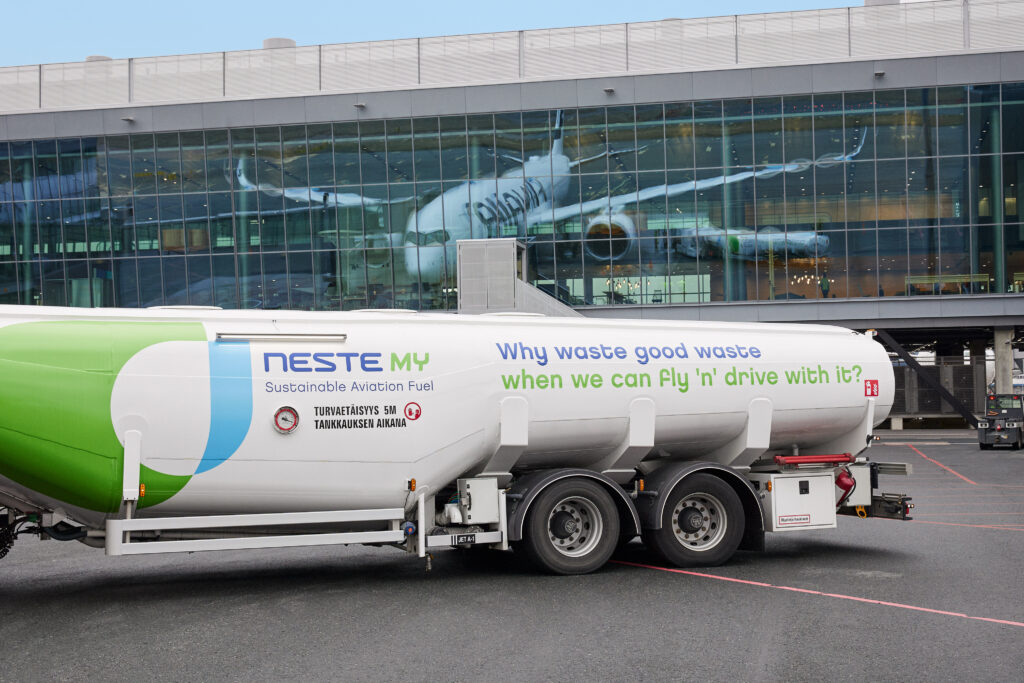
Notably Ryanair has finalised agreements with Neste (of Finland) to power 12.5% of its flights with SAF by 2030. Wille Walsh outgoing IATA DG: “Five years after committing to achieve net zero by 2050, the path to meeting 65% of our needs in 2050 is growing more difficult with each year of ineffectively sequenced government policies and oil companies manifest lack of interest”
Governments and oil companies ignored the airline industry’s clear statements in 2021 it would buy SAF. Airlines have pushed whilst most governments and the oil industries have taken a rear seat or even walked away from investing in sustainability including SAF.
With a current production capacity of some 9 million tonnes, only 2.4 Mt will be produced through the end of the year. IATA expects a potential capacity by 2030 of 20 Mt with Europe at just 6 Mt. The current and continued price of SAF is out of reach of many airlines. IATA is seeing a looming shortfall in production and adoption and up to one third of the SAF projects promised by the end of this decade may never reach operational viability.
IATA estimates shared at its June AGM indicate global production as a fraction of what is needed at just 2.4 million tonnes this year or 0.8% but costing $4.3 billon to airlines; and insists governments must step in.
- Air Canada and Airbus: Announced a joint investment platform to support commercial scale SAF production in Canada committing some $9 to $10 million. Airbus head of SAF and Carbon Dioxide removals Julian Manhes said “The partnership shows Air Canada is putting its money where its mouth is.” Investing in SAF is not easy because some 200 projects are trying to scale up around the world with investors slow to commit to a likely ten year goal.
- Long term offset agreements: More are needed to scale up SAF volumes to help the whole air transport industry though what is being called “The Valley of Death” scale up period. The European Commission proposal to expand the scope of its Emissions Trading System (ETS) and associated ReFuelEU has mandated 6% SAF usage by 2030, which most say is unrealistic.
SAF can bring down life cycle carbon emissions by 80%. The most viable method to produce SAF at volumes is through the process of hydroprocessed esters and fatty acids HEFA. Where feedstocks like cooking oil, biomass waste and residues can be converted into jet fuel in bio refineries, as Neste does.
Example: a Chinese SAF refinery is capable of converting ten thousand barrels a day of cooking oil into jet fuel. The end product is already certified with no engine mods required. Canada’s method is from wood residue via a Gasification Fischer-Tropsch (GFP) process.
ATR, Regional Turboprops, one of the standard bearers on SAF adoption initiatives has called for pragmatic EU measures to accelerate its uptake across Europe and overcome current supply constraints and industrialise these technologies at scale.
Enter eSAF. Unlike SAF which is made from bio waste and renewable organics, electro or synthetic SAF is made by combining hydrogen from water and captured carbon dioxide: ‘Power to Liquid’. The drawback is the high cost of eSAF electrolysis, even above SAF and far above fossil jet fuel price, even today. The positive is research shows basic physics applications can lead to much lower costs of eSAF production.
However European airline CEOs are calling for EU 2030 mandate to be delayed as not achievable due to lack of credible supply. The EU is expecting 6% bioSAF and 1.2% syntheticSAF by the decades end, with expensive penalties for non use by then. Ryanair’s CEO O’Leary believes it is “inevitable” the EU will delay the mandate in the next year or two into the mid-2030s.
From the airlines perspective “eSAF needs to become commercially viable” says KLM CEO Marjan Rintel, adding “it is crucial to have a regulatory framework that reflects market realities”.
Willie Walsh: “While I fully support the long term ambition of eSAF, the short term ridiculous focus makes no sense”
European Commissioner for sustainable transport and tourism A. Tzitzikostas, whilst acknowledging the current difficulties: “The Commission is fully committed to EU aviation’s well defined targets”
Supply Chains
As reported here in FII two years ago, supply chain bottlenecks and disruptions continue to delay airliner deliveries with airlines short of some 5,000 replacement aircraft and the order backlog is at 18,000. IATA estimates that $11 billion in 2025 was lost by the world’s airlines due to new aircraft delays running into years and the MRO costs of running now older fleets. More than 2,000 narrowbodies worldwide are past their expected retirement age.
Behind the delayed backlog of finished production airliners, the chain is substantial: shortages of engines, machined structural components – forgings, castings, interiors, avionics, spares, MRO capacity and not least raw materials, titanium and specialist alloys. This all exacerbated by a worldwide shortage of skilled labour: machinists, aerospace welders and maintenance technicians.
The old practice of ‘Lean supply chain’ now results in a struggle to adapt. Airbus is now focused more on production stability than more orders (of which it has many). Like Boeing, manufacturing quality issues, supplier delays especially engines, being the constraints. 114 Airbuses were delivered in 1Q26 (Boeing 143) with a year end target of 870! New delivery slots are hard to get and there is a “race for dwindling delivery slots” says IBA Group of Surrey GB. Boeing MAX and A320neo production positions for new buyers are now limited out to 2033.
Additionally, the Arabian peninsula choke points also influence the global supply chains, with sea freighter availability, transit times and competing demands for other industry products.
MRO shops, engines most of all, are equally affected with parts shortages, particularly hot section and LLPs (life limited parts). Turn around times for engines can in some cases can be up 150% from 35%
IATA AGM Rio de Janeiro
The oil industry came in for one of outgoing DG Willie Walsh biggest critique who he says have walked away from their SAF production promises. This at a time of unprecedented JetA1 pending shortages and associated price spike. “That’s before we even consider the hypocrisy of governments talking a good game on sustainability and competitiveness while dragging their feet on meaningful reforms” said the fiery Walsh: airspace restrictions or closures in particular as well. Globally, average jet fuel prices will be 70% higher year on year adding $100 billion to the world airlines collective fuel bill this year, says Walsh.
P&W GTF recovery
The PW1100G engine on the A230neo will remain an issue for another two years says one unnamed A320neo operator. P&W states the company remain on target for single digit AOG by years end (320neo airlines in South Asia and central America are not so optimistic) and “finally in 2027 or 2028 get this behind us”. At the peak some 650 GTF powered neos were AOG. Ten years after EIS the plagued GTF continues to deal with its durability issues, the latest: supplier level production powder metal contamination; following material flows, the root of many issues, HP turbine blades and heat exchanger degradation.
P&W has invested in building / expanding / licensing MRO facilities, 21 of, running into hundreds of millions of dollars to deal with GTF problems; up 300% since 2019. Additional measures that are certified, include Hot Section Plus (HS+) upgrade kit of 35 part numbers; and by 2028 the upgraded GTF Advantage. PW aims to switch all production to this new variant.
CFMI LEAP durability enhancements
Certified or working to certification, high pressure turbine; reverse bleed system (RBS) for fuel nozzle durability and longevity kits are now available for Leap 1As and 1Bs. Both are part of broad projects to prevent parts from prematurely degrading in the hot sections which run at hundreds of degrees hotter than on previous CFM56s. Turbine blade(s) plastic deformation ‘creep’ being one such in-the-field problem. Improvements to casting and cooling being a solution.
Leap turbofans operated in the Middle East and India are particularly susceptible to component degradation due to their hot and dusty conditions. All improvements are to increase time-on-wing, reduce AOG and maintenance burden. Also, to this end CFMI in investing over the next 5 years $2 billion to support LEAP aftermarket support and improve turnaround times.
The company plans to deliver nearly two thousand LEAP engines by years end at more than ten thousand delivered to date.
Opinion
The author noted an Elephant-in-the-room at Farnborough that only a few civil aviation speakers or media tactfully mentioned but only in the critique of Governments per se. There was and is, a huge gulf (pardon the pun) in promised political investment between the NATO military air arms and the civil air transport world. Exhibiting and displaying literally side by side, no one, publicly, from civil aviation pointed at this discrepancy or even at the Trump administrations war of choice without exit on Iran leading to the above JetA1 spikes and airspace / hub disruptions; which were all very predictable.
The EU Commission and its major capitals likewise escaped zero pressures to reconsider aerospace priorities to invest and spend on what-is-now: SAF crisis of supply, genuine aviation sustainability, supply chain improvements. Instead like the UK, continued to trumpet ‘defence’ investment by firms, mostly from their tax coffers, in what-might-be scenarios: suspicions or even outright political paranoia of several Eurasian / Asian powers ie. the ‘usual suspects’.
Trade, not just air transport is 24/7 worldwide, here, now and tomorrow. One of ICAOs defining principles from its inception, Chicago Convention, was the free and economical passage of air carriers i.e. “Five Freedoms”. Defence of Realms are a noble endeavour but also includes their commerce and trade, including routes. As always it seems, Peter is being robbed to pay Paul.
Part 3 Airbus & Boeing global market forecasts and their current production, certification developments
Main photo above by Ger Murphy.