


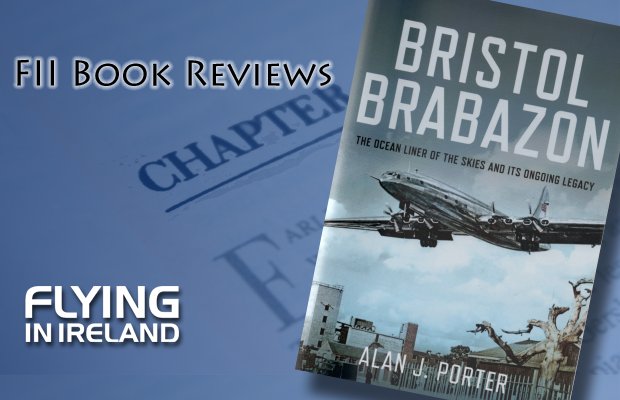
Bristol Brabazon – The Ocean Liner of the Skies and its Ongoing Legacy by Alan J Porter, 259 pages HB, 16 B&W photographs, £29.99, Pen & Sword, ISBN 1399055682
‘Saturday 25th August 1951, Bristol 167 Brabazon I, G-AGPW, seen overhead Bangor at 2,000 feet, the massive silver aircraft made a left turn to head back to the Sydenham Air Show. The eight Centaurus engines, each coupled to four contra-rotating propellers, made a very strange deep whirring sound which seemed to hang in the air after the aircraft had passed.’ These were the thoughts of the late Bob Wilson, recorded in his spotting log. What I didn’t know before reading this book was that, ‘In Belfast, for the first time, the aircraft carried passengers other than government officials, technicians, or members of the press, as a group of Air Training Corps Cadets were allowed on board for one flight’. Lucky them! On the way back to Bristol it flew over Dublin to the delight of another enthusiast, Éanna Brophy, ‘The Brabazon truly was an awesome thing to behold in our skies, which up to then had seldom seen anything bigger than an Aer Lingus DC-3. To us it seemed to be flying perilously close to the rooftops, and moving so slowly that it might lose all momentum and drop out of the sky.’
The author, while working as Head of Tech Pubs at BAe Filton, was inspired to write this book (albeit 30 years later!) by the chance discovery of a discarded manual – Brabazon Mark I Handling and Servicing Notes – in a bin behind the Brabazon Hangar. I visited the hangar in the mid-1980s, no doubt when the author was working there. It is a mighty edifice, at that time filled with VC-10s being converted to tankers for the RAF.
Alan Porter has done a very comprehensive job, beginning with a brief history of the Bristol company, founded by Sir George White in 1910 (though he does seem to confuse the Bristol Scout with the M.1C), moving on to set the scene by describing the composition and function of the Brabazon Committee; set up in 1942 to think about the future of British civil aviation post-war. He then gives us a concise survey of pre-war passenger air transport. He convincingly makes the case that – in the context of the time and the immediate years before – it was not totally wrongheaded to think that future of transatlantic air travel might be akin in luxury and comfort to that provided by the Cunard Queens.
It does seem strange that the job was given to Bristol, which had not previously been a manufacturer of airliners (apart from the unique Bristol Pullman triplane of 1920). What doesn’t surprise is that BOAC had a major input on the configuration and promptly dropped the project in favour of ‘buy American’, which, to be honest, was a wise decision.
The Brabazon was hugely innovative and ambitious technically, politically driven by wishful thinking and decidedly not ‘off-the-shelf’. The actual aircraft was not only vast in scale (comparable to the B-36 Peacemaker) and concept; the civil engineering and construction tasks were also immense. The project needed the enormous new hangar at Filton, as well as the demolition of the village of Charlton to accommodate the lengthening of the runway. The author is to be congratulated for his candour and the diligence of his research and the way he sets his story within the contemporary social and political scene. His conclusions are considered, balanced and, to me, convincing.
The Brabazon I was always intended to be a test bed, the Brabazon II would have had turboprop engines. An initial production run of just eight aircraft was planned. To me this sounds like the economics of the 1920s and 1930s – not the post-war era. It was never going to be a commercial proposition, it was more of a work of art, design concept brought to life or a study in advanced engineering – at on or just beyond the bounds of what would work. The technical challenges of design and construction are very fully covered for both the Brabazon I and II. According to the test pilots, AJ ‘Bill’ Pegg and Walter Gibb it was very nice to fly; quiet smooth and spacious.
The selection of photographs is good, though I do wish there had been a few more of them, particularly the colour cutaway from the Eagle comic which the author mentions! The book is then rounded off by several interesting and useful appendices.
This is a well-written and engaging account of an important piece of our civil aviation history, which I would have no hesitation in recommending to a wider audience.

