


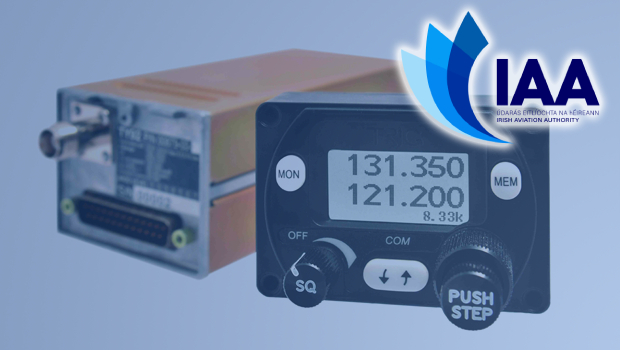
The Irish Aviation Authority has published updated information explaining a change in EU regulations regarding the mandatory use of 8.33 kHz channel spacing capable radios for General Aviation. IFR flights into Class A, B, and C airspace, and flights operating above FL 195 have long required 8.33 kHz radios. The last remaining radios to be converted were those operating VFR in Class C and G airspace within the Shannon FIR, excluding Dublin Airport (EIDW).
As a result of an IAA exemption, regulations required that all radios used in ‘Airband’ frequencies be 8.33 kHz capable from 31 December 2024. Changes to EU regulation mean that some aircraft and ground stations can continue to use 25 kHz spacing radios beyond this date – good news for many!
Annex I and Opt-out aircraft may continue to use 25 kHz spacing capable radios. Radios put into service before 17 November 2013, in EASA aircraft, may continue in service. Radios put into service after 17 November 2013 must be 8.33 kHz capable after 31 Dec 2024 – according to the IAA, this date won’t change. Ground radios can continue on their assigned frequency unless that frequency is changed to an 8.33 kHz one.
They remind pilots that, regardless of the information above, where the flight(s) occurs within or into airspace, or along routes, that have been designated by the competent authority as requiring two-way communication then suitable voice communication must be used. That means if you’re flying into an airport, you must be able to select the frequency on the radio that you’re using – an older radio might not be able to select 124.68 MHz, for example.
Other legislation requires tower frequencies to be upgraded to 8.33 kHz, so it’s important to check the assigned frequencies in any Class C airspace or Radio Mandatory Zone when planning your flight.
This is excellent news for pilots of aircraft used in Class G airspace and relying on a Flight Information Service only. The last report from the IAA, following an Air-Ground Communications survey, recommended that FIS frequencies remain on 127.5 MHz and 118.5 MHz.
Flights into the Scottish FIR and into Dublin Airport (EIDW) already require 8.33 kHz channel spacing capable radios. It’s probable that Weston (EIWT) will convert to a new frequency next. Then, it’s only a matter of time before all the airports change their frequencies, but it looks likely that use of older radios in Class G airspace will continue.

