


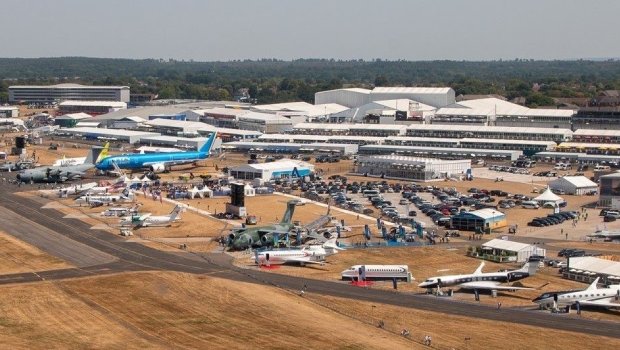
In one word, Titanium.
The supply-chain ecosystem
Amidst all the displays, static, flying and in the halls, one item received limited commentary. Deliveries of new airliners and engines cannot keep pace with demand and this situation is predicted to last at least another two years. IATA said supply chain issues continue to affect global trade and business, from critical suppliers delivery delays of aircraft parts; extra maintenance issues on some engine types; manufacturing quality control failings; to finding raw materials and electronic components.
These and associated conditions have left airlines with about 2,000 fewer new airliners, due to and if not for the production slowdowns. For example, JAL or Korean will not receive their Farnborough orders until 2028.
Enter the Law of Unintended Consequences:
The supplier system is far less stable than before the 2020 pandemic and has not yet recovered predictability or stability and this situation is not going away. Alternative long-term sources of titanium lead the headaches, now Russian metals giant VSMPO has been sanctioned since 2022 (this author noted many new Hall stands advertising their Titanium solutions, compared to previous Farnboroughs).
Apart from new regulations concerning the environment and sustainability; re-hiring of workers laid off during Covid; geo-tensions have added to supplies interrupting our interconnected world – Sea freighters and tankers in many cases are ordered to traverse Asia-Europe via the Cape of Good Hope to avoid potential attacks in the Red Sea. (This can add many days even weeks to arrival).
Formal paperwork has increased on exports in particular for End-User certificate proofing, as anyone found delivering parts, even innocently, to a third party that ends up in Russia will be heavily jumped on. Such proofing of a string of export transits inevitable takes more time and of itself delays. Microchip sourcing adds further uncertainty due to new East-West commercial/political suspicions.
Airlines recently have been retiring only one to 1.5% of their airliners annually; down from an average of 3% in the decades before the pandemic.

Airbus and Boeing 20-year crystal-ball forecasts – World fleets to double?
Airbus expects demand through to 2043 for 42,430 new pax/freighter aircraft: 33,510 single aisle; 8,920 twin aisle, with 23,970 for growth and 18,460 as replacements. Increasing global fleet from 24,260 to 48,230 aircraft to satisfy 3.6% annual traffic growth. Airbus has a backlog of 8,626 airliners as of March this year. Monthly production build rates are:
- A320neo in the 40 to 50 zone, down from a 75 target (put back to 2027)
- A350 stands at 12 per month
- A330neo four per month
Boeing has raised its forecast and now predicts that airlines will need 43,975 new airplanes to 2043. An increase of 1,375 aircraft over its previous 2023 prediction; anticipating that a large number of older models must be replaced soon. In these two decades Boeing projects that the global pax and freighter fleet will nearly double to 50,170 airplanes. Single aisle will account for 71% in 2043 and 76% of new deliveries – 33,380. Widebodies at 17% of new deliveries – 8,065. The world cargo market demand will reach 2,800 freighters in 20 years. At an average annual traffic growth rate of 3.2%. Eurasia is projected to lead all markets.
“Capacity is constrained by the availability of new aircraft; retirements are delayed as a result” says Boeing. Monthly production of its B737MAX is running at an average of 25, down from 38. Additionally, Boeing’s 2043 outlook projects the following need for new aviation personnel:
- 674,000 pilots
- 716,000 maintenance technicians
- 980,000 cabin crew
The new A321XLR – including six for Aer Lingus

This was the only new airliner in the daily flying display. EASA certified this type with CFM Leap-1A on 19th July. Similar certification for the PW1100G option will follow later this year. Iberia will be the launch customer, replacing Aer Lingus by parent IAG because of their recent pilot pay dispute. The Irish carrier will then launch new routes with the type to North America and perhaps also eastbound?
Changes and differences comprise an MTOW of 101 tonnes; new main undercarriage and flaps; high capacity water & waste systems and cabin emphasis on both passenger and crew comfort as this model can fly for six hours with 200 pax at ranges of 8,700km (4,700nm).
The major change to the A321neo is a 12,900 litre integrated rear centre fuel tank, behind fuselage frame 47, taking overall Jet A-1 capacity to almost 40,000 litres. This tank’s size and location presented EASA with specific fire safety challenges concentrating on three specific aspects of ignition risk in a survivable crash landing:
- Thermal insulation between the tank’s upper surface and cabin floor above,
- A protective tank liner resistant to damage and spillage,
- An extended and reinforced belly fairing.
The only drawback as Aer Lingus cabin crew tell me is that cabin service can be a real pain on single-aisle long haul.
Boeing – Regaining Trust
The aeroplane manufacturer did not bring any of its newest commercial aircraft to Farnborough citing the airframes are concentrating on extended test and certification matters. The company has also turned its attention to a comprehensive safety and quality action plan the FAA ordered Boeing to devise after the regulator launched an investigation into reports of systematic quality control deficiencies in the MAX and 787 production lines.
The plan calls for simplifying processes, investing more in robust training and mentoring programmes; and increasing oversight of its suppliers.
Boeing will now acquire Spirit AeroSystems of Wichita which it spun off in 2005, as part of outsourcing, a major supplier of MAX fuselage sections and source of extensive quality control lapses leading to rework. However Boeing ‘owns the problem’.
Observers have claimed Boeing’s engineering and quality decline goes back to its acquisition of McDonnell Douglas in 1997 and its associated share price gains management strategy.
Boeing says, unlike the MCAS fatal accidents, rectification emphasis is moving from engineering to production and manufacturing disciplines.
Boeing’s quality VP has also come under fire from the NTSB for commenting publicly on the ongoing NTSB investigation into the door plug incident in January. Allegedly correct paperwork documentation was not in place on the production line which allowed fitters to reinstall the door plug without four retaining pins. The airframer continues to work on three long-delayed models, the MAX-7. MAX-10 and 777-9. Willie Walsh IATA Director General and former IAG chief executive says he is “very confident” that Boeing will overcome its current production difficulties.