


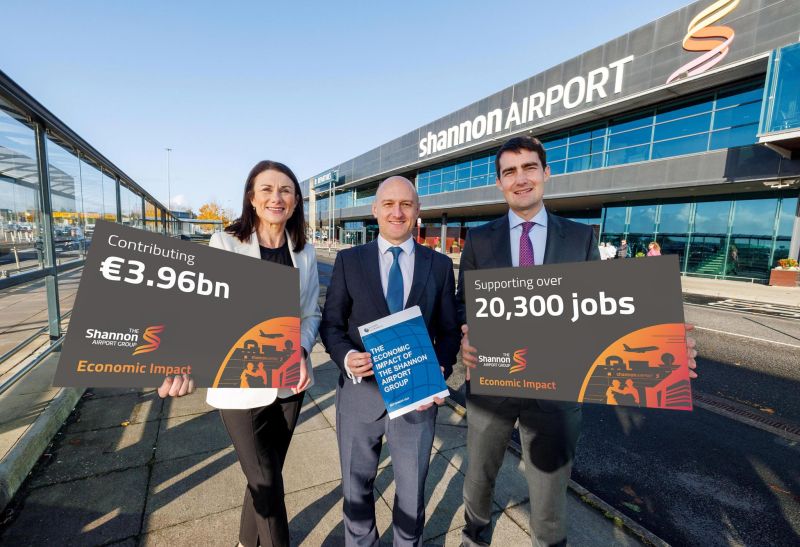
The Shannon Airport Group (SNNGroup) commissioned Oxford Economics to quantify its economic contribution to the Irish economy. The economic footprint of the Group incorporates the impact of the Airport and the businesses located across the Group’s business parks, which support thousands of jobs and contribute billions to GDP. We have included some extracts from the report below, a link to the full report is available at the bottom of the article.
The core economic impact of SNNGroup contributed €3.96 billion of GVA to Ireland’s GDP in 2022 and facilitated 20,330 jobs across the Irish workforce. SNNGroup’s economic footprint is concentrated in the Mid-West. In 2022, the core impact contributed approximately €3.29 billion to the Mid-West economy—equivalent to around 6% of the region’s GVA—and 15,710 jobs.
The core economic impact comprises the direct activities of SNNGroup and the aviation and property activities facilitated by SNNGroup, the indirect activity supported along the supply chain, and induced activity through wage consumption, as illustrated below. The direct economic impact of SNNGroup contributed €2.58 billion in GVA to Irish GDP in 2022 and 11,300 jobs. The economic contribution is concentrated in the Shannon Campus, which contributed an estimated €2.32 billion or 90% of direct GVA and over 10,000 jobs.

The indirect economic impact contributed approximately €753 million of GVA to Irish GDP and 4,560 jobs. This accounts for the broader impact of SNNGroup, beyond the direct economic contribution of its firms, which ‘ripples’ through the regional and wider Irish economy. At the centre of a complex network of supply chains, SNNGroup and the aviation and property activities facilitated by SNNGroup enable further economic activity throughout the Mid-West and the broader Irish economy. Based on the typical purchasing patterns of Irish firms, the report estimates that the €1.19 billion spent on procurement by the hundreds of firms across SNNGroup with domestic suppliers, and the associated supply chain effects.
The induced economic impact generated a further €634 million GVA contribution to Irish GDP and 4,480 jobs. The induced impact accounts for spending by employees across SNNGroup and along its supply chains which provide an invaluable contribution to the local consumer economy.
Shannon Airport
The flights that Shannon Airport provide boost Ireland’s long-term economic potential, by linking Irish firms to airports and therefore markets across the globe. The provision of these transport services involves far-reaching interactions between businesses at the Shannon Campus, across the Mid-West, and the rest of the Irish economy. The report estimates that the connectivity provided by Shannon Airport in 2022 will boost Ireland’s long-term productivity by 0.15%, meaning that Irish firms can produce goods and services more efficiently over time. Shannon provides access to foreign markets which enables trade and investment, enabling Irish firms to adopt new technologies and ideas, and leading to greater innovation and a more highly-skilled workforce. The connectivity provided by Shannon Airport represents a positive contribution to improving productivity, which is a key determinant to enable the nation to become richer over time, allowing businesses to grow more profitable, living standards to improve, and governments to spend more on infrastructure and public services.
Moreover, Shannon Airport plays an enabling role for Ireland’s tourism sector. Despite the travel restrictions in place due to Covid-19, the Airport handled over 1.5 million passengers in 2022 (including transit traffic). The report estimates that Shannon Airport accommodated 376,000 international visitors in 2022, whose spending across the Irish economy contributed €146 million to GDP and 1,860 jobs. The Airport is also an enabler of trade in the economy. The facilitation of goods imports and exports through Shannon Airport contributed €1.36 billion to Irish GDP and 10,490 jobs in 2022.

Policy Environment And Stakeholder Consultation
While the outlook for growth in the aviation sector is positive, Ireland’s aviation sector is one of the most concentrated in Europe. Dublin Airport forms a higher share of aviation activity than across comparator European nations and has captured almost all of the recent growth in passengers across Ireland. It may be that this is partly due to the aviation and economic policy decisions made by the Irish Government, such as excluding regional airports serving more than one million passengers from financial support provided under the Regional Airports Programme and decisions by the Commission for Aviation Regulation to fund continuous capacity expansion at Dublin Airport without consideration of the impact this has on national infrastructure and regional balance.
Rebalancing passengers to regional airports, such as Shannon, will bring a range of benefits to the Irish economy. A strong regional airport assists in building a more vibrant business environment, helping to unlock growth. If a country has an excessive reliance on a single airport, any disruptions, such as labour shortages, natural disasters, or technical failures, could cause a significant impact on the tourism sector, as well as the economy as a whole.
Supporting regional airports will also enable the Government’s wider regional growth objectives, as set out in Project Ireland 2040. However, the reports’ baseline forecast indicates that the desired spatial rebalancing of economic growth is unlikely to materialise without substantial intervention, with population and employment expected to continue to be concentrated across the Eastern & Midland region (including Dublin).
The National Aviation Policy predates the Project Ireland 2040 development strategy, and a review of aviation policy is needed to accommodate the Government’s ambitions for rebalancing regional growth across Ireland. There would also be a series of environmental benefits that would support the Government’s efforts to tackle climate change, such as reducing noise in residential areas or pollution from large-scale expansion projects in Dublin Airport.
However, despite the economic and environmental benefits, Irish aviation policy has to date failed to create a level playing field for its regional airports to flourish. While EU guidelines allow for state aid to be granted to airports with fewer than three million passengers, the Regional Airports Programme does not provide state aid to state-owned regional airports, such as Shannon. This makes it harder for Shannon to compete with larger and more profitable airports, which find it easier to attract suitable financing due to greater profitability. The recent rise in the price cap on passenger charges also helps Dublin Airport to continue to expand and invest, whereas regional airports are forced to lower prices to compete with Dublin, limiting their ability to invest.
To better understand the role of SNNGroup as an organisation contributes to the Mid-West economy, the report’s authors spoke to stakeholders in the region. Participants unanimously recognised the paramount role of Shannon Airport in supporting the economy, attracting FDI, facilitating exports, and driving tourism. They also raised concerns about congestion and centralisation of economic activity in Dublin, highlighting the need for balanced regional development and a comprehensive aviation policy. Finally, stakeholders highlighted opportunities for growth, emphasising the importance of enhancing connectivity to continental Europe, including major hubs like Amsterdam and Frankfurt, and better inclusion of Shannon Airport in tourism promotion.
Click here to read the full report.

