


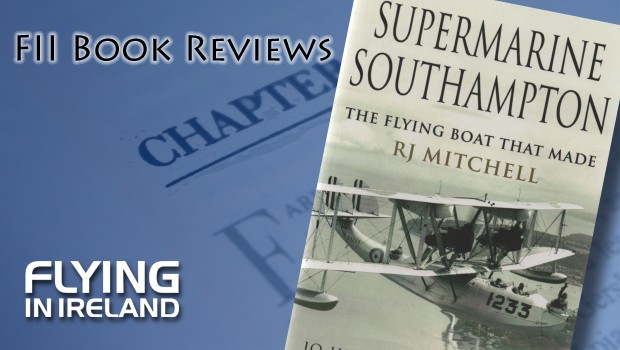
Supermarine Southampton – The Flying Boat that made RJ Mitchell by Jo Hillman and Colin Higgs, 226 pages HB, 240 b&w photographs, 1 map, Pen & Sword £25 ISBN 1526784947
Supermarine Southamptons visited Northern Ireland on at least three occasions between the wars. The first two times were in 1925 and 1926 by 480 Coastal Patrol Flight, the third by No 201 Squadron in 1933. The sole remaining survivor, N9899, which suffered a forced landing into the sea and was towed by the cruiser, HMS Calliope, to a Harland & Wolff slipway for repairs, is on display in the RAF Museum, Hendon. I thought, therefore, that a book specifically on this seminal type might shed further light on these important, trailblazing ‘cruises’. So, on first opening the cover, I was slightly dismayed to find that the authors declared in their Acknowledgements that ‘the photographs are the star of the book …as it is the pictures that tell the story.’ Well… up to a point they do.
The upshot is that there are no less than 240 images, some of which are excellent and of considerable interest in themselves, but sadly none were taken on Belfast Lough, Lough Neagh or the River Foyle, where there is no doubt that Southamptons alighted. Some have extended captions, which are quite informative but there are only twenty pages of text. Reference to Northern Ireland is minimal.
Leaving this all aside, the photos are arranged in chronological order, starting with some early Supermarine types, though the image on page seven is not a Supermarine Baby, as captioned. It is a Walrus. So that doesn’t really get us off to a good start. I enjoyed looking through the photos but would question why – in a picture book – would you spoil a lot of rare, images by spreading them across two pages? The photos are interspersed with short essays of between half a page and a page and a half, briefly covering development, construction (30 blow-by-blow photos), flight and squadron service, overseas cruises, foreign operators, a loan to Imperial Airways, experimental versions and the discovery and restoration of N9899. The best bits for me were the nine pages at the end devoted to a production list. A bibliography is not included. I could recommend several very informative and detailed sources for anyone seeking to learn more about the Southampton.
As readers may have gathered, this concept doesn’t really work for me, it feels to me a bit of a wasted opportunity, perhaps it would be a more useful book for model makers, particularly those talented enough to scratch build?

