


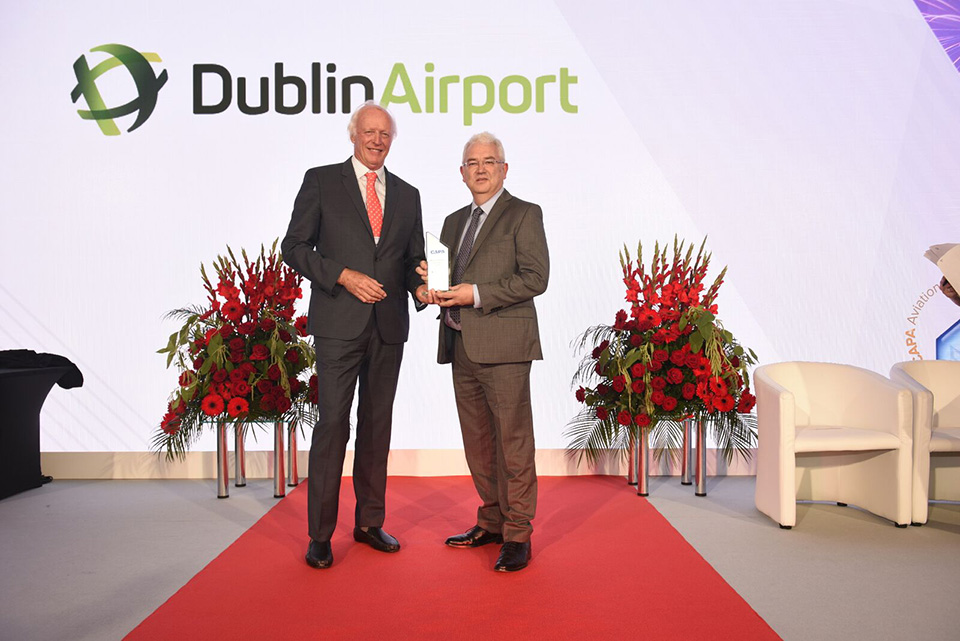
Main Photo: CAPA Executive Chairman, Peter Harbison presenting Dublin Airport Managing Director, Vincent Harrison with the Airport of the Year Award
Dublin Airport was named Airport of the Year in the category for medium-sized airports that have fewer than 30 million passengers per annum, while Amsterdam Schiphol won the category for large airports with more than 30 million passengers per year.
“This is a very significant achievement for Dublin Airport and for Ireland,” said Dublin Airport Managing Director Vincent Harrison. “Winning this award is a recognition of the excellent year that Dublin Airport enjoyed in 2016, as we welcomed 19 new routes, increased passenger numbers by 11% and continued to provide an award-winning customer service product,” he added.
“It’s a huge honour to accept this award on behalf of the entire team at Dublin Airport, including our staff, our airline customers, our commercial partners and the 27.9 million passengers that we welcomed last year.”
Dublin received its Airport of the Year Award at the 2017 CAPA-ACTE Global Summit in London last week. Now in their 15th year, CAPA’s Aviation Awards for Excellence are intended to reward airports, airlines, and individuals that are not only successful, but have also provided industry strategic leadership in an ever-changing aviation environment. Award candidates were independently researched and short-listed by CAPA’s global team of analysts for performance over the past 12 months, and vetted by a small panel of independent industry experts.
“Through a strong trade presence and active business development strategies, Dublin Airport has been able to take advantage of its geographical position to become a true trans-Atlantic gateway between Europe and North America,” said CAPA’s Executive Chairman, Peter Harbison.
“Dublin’s growth over the past few years has been phenomenal and, while supporting new entrants like Norwegian, with Aer Lingus and Ryanair as its main customers, its growth potential is massive,” he added.
More than 2.7 million passengers passed through Dublin Airport in September, a 6% increase on last year, making it the busiest September in the airport’s 77-year history. Passenger numbers to and from continental Europe increased by 8% with almost 1.5 million passengers travelling to European destinations during the month. Just over, 813,000 passengers travelled to UK destinations in September, which is a 1% decrease over the same period last year.
Transatlantic traffic to North America increased by 19% in September, as almost 377,000 passengers travelled on this route sector last month. More than 76,000 passengers travelled to the Middle East and North Africa, an increase of 15% when compared to last year. The number of passengers taking domestic flights fell by 2%, with 7,700 people travelling on domestic routes last month.
So far this year, the number of passengers using Dublin Airport as a hub to connect to other destinations has increased by 40%, with almost 1.2 million passengers connecting at the airport between January and September. In total, more than 22.7 million passengers have travelled through Dublin Airport in the first nine months of the year, a 6% increase when compared to the same period last year. Dublin Airport has welcomed an extra 1.3 million passengers in the first nine months of the year.
Aer Lingus & DAA Clash over Infrastructure Development
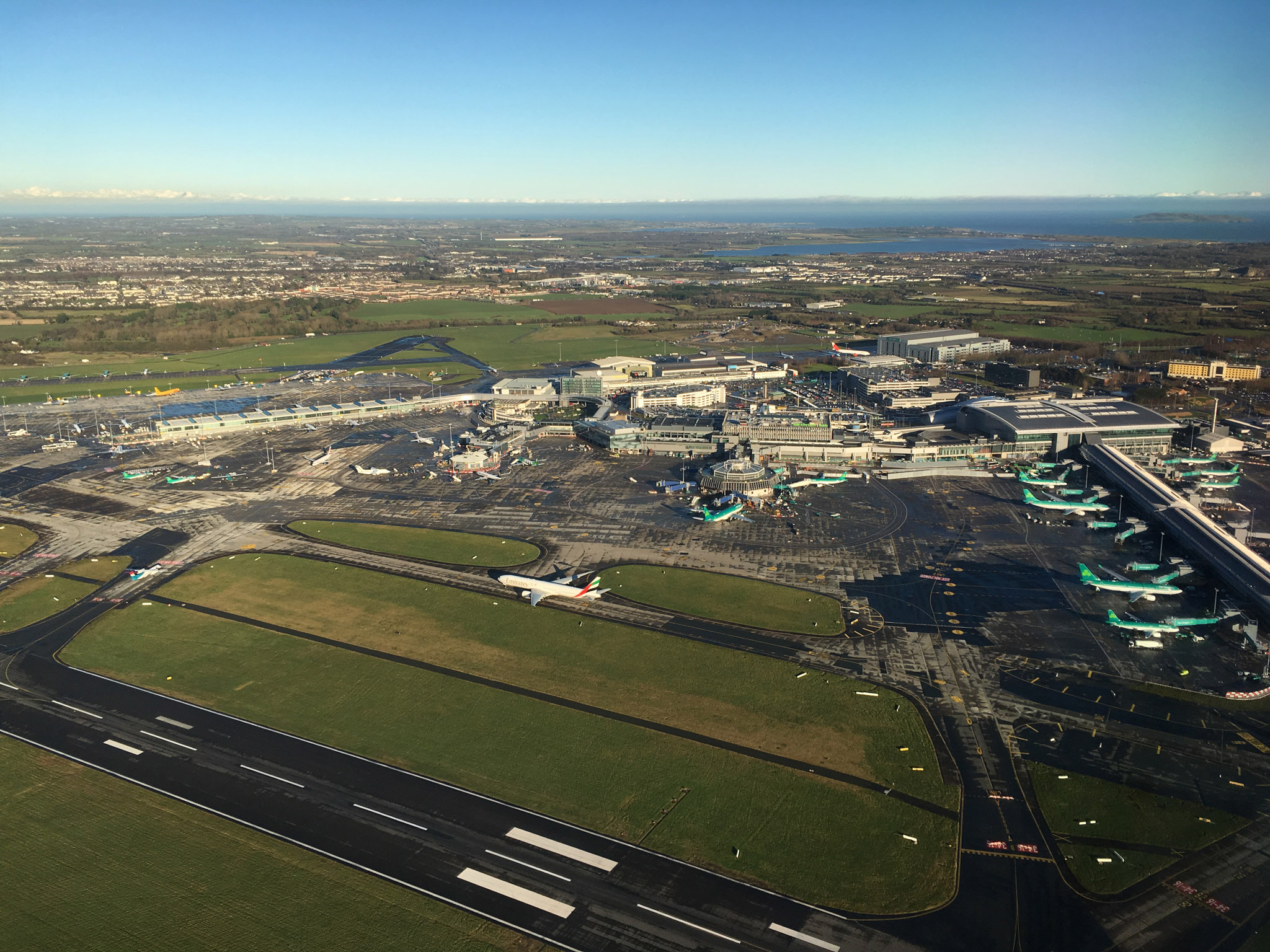
The rapid expansion at the airport has not gone without its problems. A large number of departures every morning leads to significant bottlenecks on the taxiway system. It’s especially bad when the weather precludes the use of runway 34 for departing traffic.
Aer Lingus Chief Operations Officer Mike Rutter has said that relations between the airline and Dublin Airport have “soured immensely in the last 12 months” as the pair clash over the DAA’s unwillingness to invest in new infrastructure to allow the airline to expand. “The ambitions to do that require investment in taxiways, CBP (customs and border protection), gates and stands,” Mr Rutter said.
Aer Lingus wants to grow its transatlantic passengers in Dublin to 4.5 million by 2020, from an expected 2.5 million this year. In its response, the DAA said “Dublin Airport is currently investing about €100 million per year to upgrade its facilities and we will shortly present proposals for an enhanced investment programme to our airline customers for consultation,”

Summer 2018 Slot Coordination
The Commission for Aviation Regulation (CAR) have published the Draft Decision on Summer 2018 Slot Coordination at Dublin Airport. There are a number of changes proposed to the hourly runway movement limits, for example, 1 additional departure in both of the peak morning hours. The proposal includes increasing the limits on the number of departing passengers in T1 and T2 from 3,375 and 3,450 respectively to 3,700 in each and increasing the limit on the number of arriving passengers in Terminal 1 from 3,390 to 3,550. The 0500Z (0600 to 0700 local) hour is the peak hour for departures. Average taxi-out time 24 minutes.

