


The Irish Aviation Authority (IAA) has published a series of extensive Temporary Restricted Areas (TRAs) to facilitate enhanced security operations as Ireland assumes the EU Presidency from 1st July 2026. These measures will introduce significant, short-term restrictions on aviation activity, particularly affecting General Aviation operations across the East Coast and in the vicinity of Cork.
The restrictions are being implemented for State security purposes, with access to the affected airspace limited strictly to aircraft authorised by the relevant controlling authorities. As is typical for such events, commercial airline operations will largely continue unaffected, while GA activity will face widespread limitations or outright prohibition during active periods.
A NOTAM will be issued in each case, and pilots should expect strict enforcement, including the prohibition of all drone activity unless prior written permission is obtained.
East Coast TRA (Dublin / Wicklow)
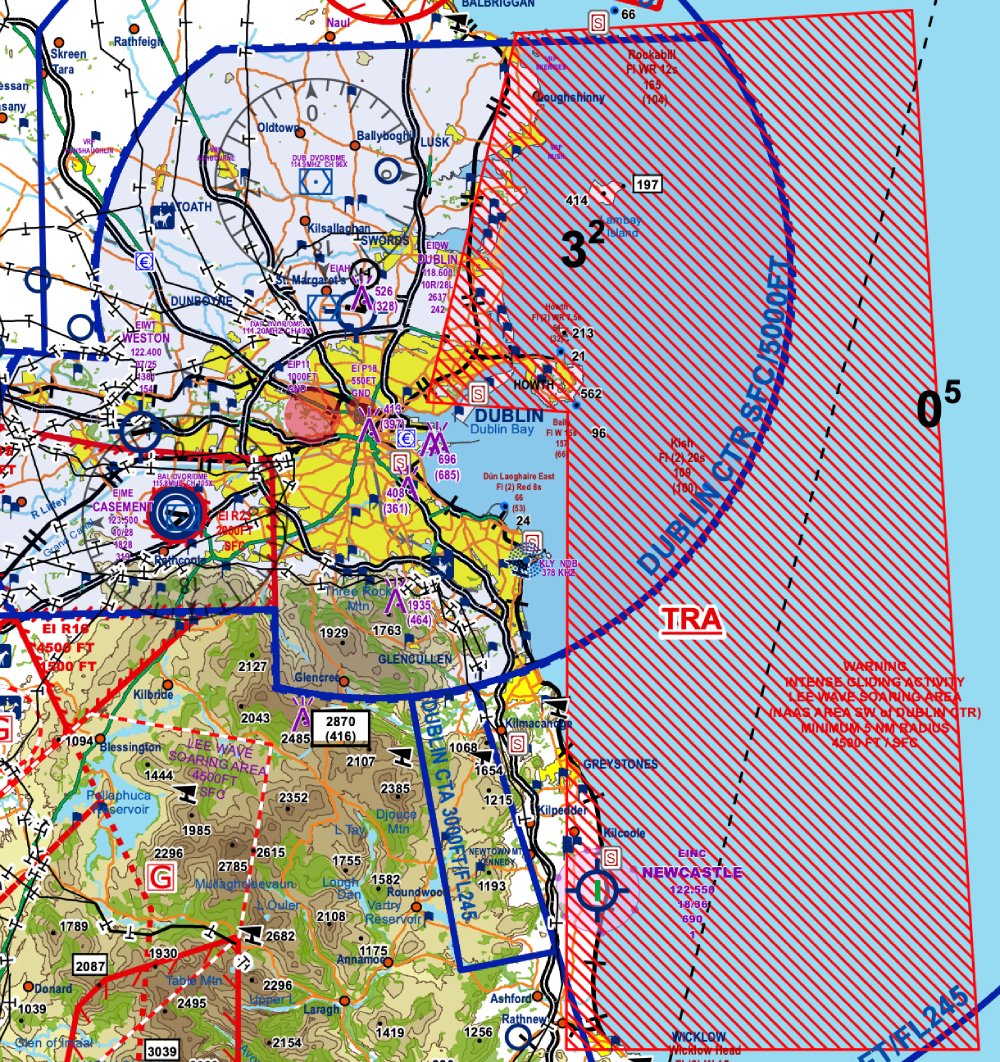
A large Temporary Restricted Area will be established covering much of the Dublin and Wicklow region, significantly impacting flying along the east coast.
- Date: Wednesday 1 July 2026
- Time: 0700–2259 UTC
- Vertical limits: Surface to 4,000 ft AMSL
- Extent: Defined by multiple coordinates covering Dublin, Wicklow and adjacent areas
This TRA effectively removes access to large portions of east coast airspace for the duration of its activation. Only aircraft operating under state authority or with specific approval from the Irish Defence Forces will be permitted. Scheduled airline traffic to and from Dublin Airport will continue as normal.
Baldonnel / Kildare TRA

A second TRA focuses on the south-west Dublin and Kildare area, including airspace associated with Baldonnel (Casement) and Weston Airport.
- Date: Wednesday 1 July 2026
- Time: 0700–2259 UTC
- Vertical limits: Surface to 4,000 ft AMSL
- Extent: Polygon extending westward from Dublin into Kildare
This restriction will have a particularly strong impact on Weston Airport operations, where only specific categories of flights may be permitted subject to military approval. Routine General Aviation activity will not be permitted within the area for the duration of the restriction.
Cork TRA

Separate measures will apply in the vicinity of Cork Airport, where a smaller but still significant restriction will be in place over a three-day period.
- Dates: 1–3 July 2026
- Times (daily): 0600–1800 UTC
- Lateral limits: 5 NM radius centred on Cork Airport
- Vertical limits: Surface to 5,000 ft AMSL
This TRA will primarily affect local GA operations, with access limited to authorised aircraft under the control of An Garda Síochána. Scheduled commercial traffic at Cork Airport will continue to operate as normal.
Operational Impact
Taken together, these restrictions represent a significant limitation on GA flying, particularly on 1 July when both East Coast TRAs are active simultaneously. Pilots will find that most east coast airspace is effectively unavailable, while Cork will experience daily restrictions over a three-day period.
Only a narrow category of flights will be permitted, including state aircraft, Coast Guard and HEMS operations, and aircraft specifically authorised by the relevant controlling authority. Outside of these exemptions, all other flights are prohibited, and standard GA exemptions do not apply within the restricted areas.
These TRAs represent one of the more extensive short-term airspace restrictions seen in Ireland in recent years. Pilots should plan accordingly, avoid affected areas entirely unless authorised, and ensure that all relevant NOTAMs are reviewed prior to flight.
Further details, including access procedures, will be available via NOTAM and through the IAA Flight Operations Department.

