


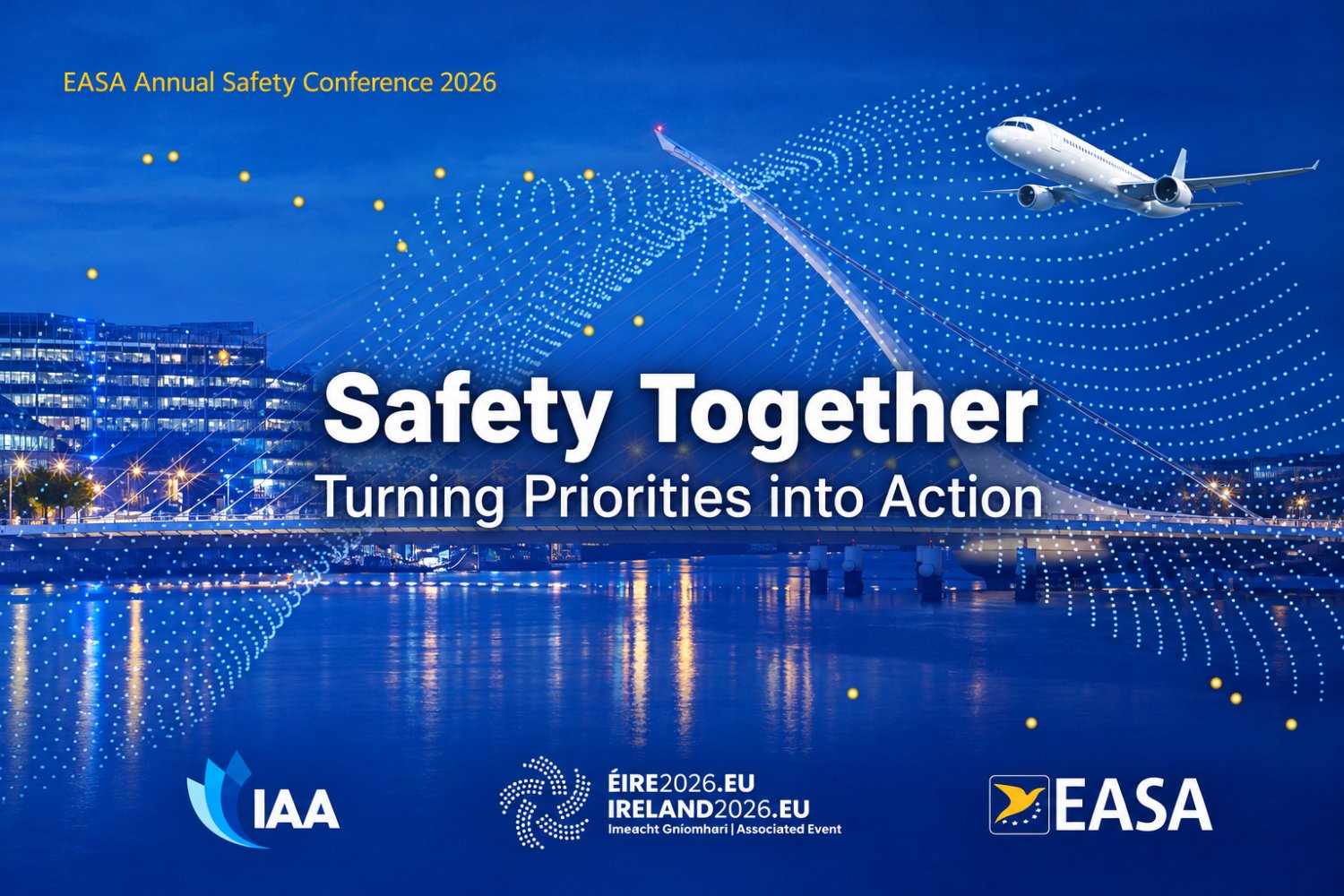
The European Union Aviation Safety Agency (EASA) has published the detailed agenda for its flagship Annual Safety Conference 2026, which will be held in Dublin on 18th-19th November at the InterContinental Dublin in Ballsbridge. The event is being organised in cooperation with the Irish Aviation Authority (IAA) and forms part of the programme associated with Ireland’s Presidency of the Council of the European Union.
This year’s conference will be held under the theme “Safety Together: Turning Priorities into Action”, highlighting the need for coordinated action across the aviation industry to address current and emerging safety challenges. According to EASA, discussions will focus on topics ranging from safety leadership and management to artificial intelligence, air traffic management systems, severe weather, supply chain resilience and future aviation risks.
Strong Irish Presence
The conference will open with a welcome address by Irish Minister of State for Transport Seán Canney, followed by remarks from EASA Executive Director Florian Guillermet. Attendees will also hear a keynote speech from Ryanair CEO Michael O’Leary, one of Europe’s most influential aviation industry leaders.
A number of Irish aviation figures feature prominently throughout the programme, including IAA Chief Executive Declan Fitzpatrick, who will participate in a panel examining emerging challenges for safety in a rapidly changing aviation environment.
Safety Challenges of Tomorrow
One of the opening sessions, titled “A New Era for Aviation: Emerging Challenges for Safety”, will examine how the industry can respond to innovation, geopolitical developments, evolving business models and the increasing pace of change. Panellists are expected to discuss how aviation organisations can build resilience while maintaining competitiveness and supporting innovation.
Another major discussion will focus on identifying the industry’s most significant safety issues through EASA’s Top Safety Topics framework, examining both current risks and those likely to emerge in the years ahead.
General Aviation and Airspace Users Featured
Of particular interest to the wider aviation community will be a dedicated discussion on conspicuity, a key EASA initiative aimed at improving situational awareness and reducing the risk of airspace conflicts. The session will explore how technology can help integrate an increasingly diverse mix of airspace users, including general aviation pilots and unmanned aircraft systems (UAS). EASA describes conspicuity as one of its priority programmes and says it is already delivering measurable results in the general aviation sector.
AI, Weather and Supply Chains
The second day agenda also includes sessions on:
- The certification and future development of air traffic management (ATM) systems.
- Aviation safety lessons from severe weather phenomena such as turbulence, icing, hail and convective activity.
- Supply chain vulnerabilities and the effects of shortages of raw materials and components on aviation operations and maintenance.
- The growing role of artificial intelligence in aviation safety management, including both the opportunities and risks associated with increased automation.
The AI session is expected to be one of the conference’s headline discussions as regulators and industry leaders consider how rapidly evolving technologies can be safely integrated into aviation operations while maintaining public confidence and robust oversight.
EASA describes the conference as its premier high-level safety event, bringing together regulators, airlines, manufacturers, air navigation service providers and other aviation stakeholders from across Europe and beyond. The event will begin on the afternoon of 18th November and continue through 19th November, with a networking reception hosted in Dublin City Hall on the evening of the first day.
With topics ranging from general aviation conspicuity to artificial intelligence and the future of ATM systems, the conference agenda reflects many of the challenges that will shape aviation safety over the coming decade. For Irish aviation, it also represents an opportunity to place Dublin at the centre of an important European conversation on the future of flight safety.

