


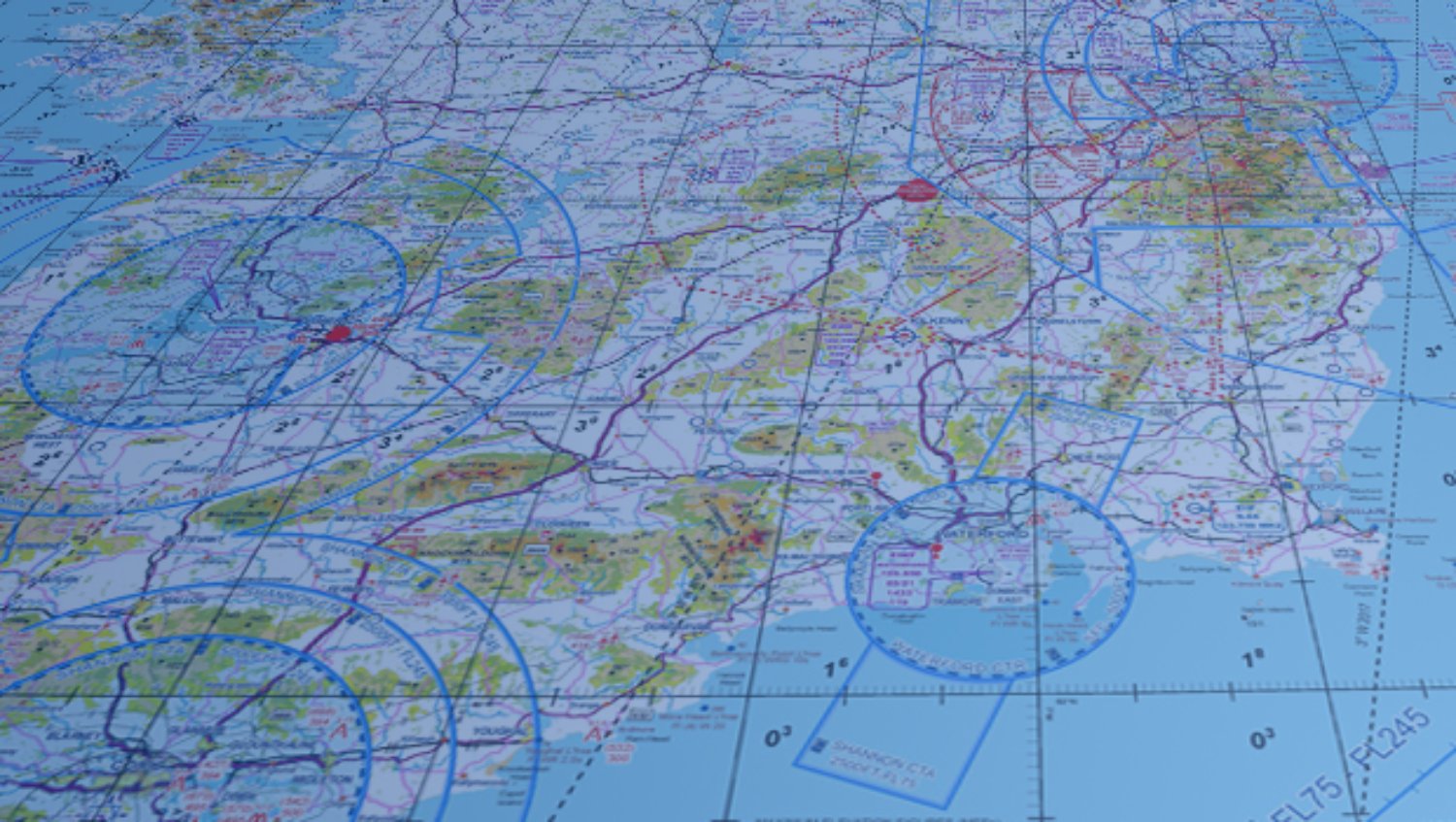
The UK CAA’s latest report on airspace infringements (CAP3277) makes for sobering reading. Based on over 1,100 infringement events in 2025, it highlights a consistent and slightly uncomfortable truth: most airspace infringements are not caused by unfamiliarity with rules or airspace structure, but by lapses in planning, discipline, and situational awareness. Although the report is UK-focused, the findings translate almost perfectly to Irish general aviation. The environments may differ in scale, but the human factors and the types of mistakes being made are strikingly similar.
Planning
One of the most consistent findings in the report is that poor pre-flight planning remains at the heart of many infringements. In particular, pilots were found to rely heavily (and sometimes exclusively) on VFR moving map tools when preparing flights. There’s no doubt that tools like SkyDemon have transformed flying in Ireland for the better. But the report reinforces something many instructors quietly worry about: when the plan lives only inside the tablet, it may not be robust enough.
Irish airspace, especially around Dublin and Shannon, is increasingly layered and dynamic. NOTAM-driven changes, temporary restricted areas, and military activity can all alter the picture quickly. A solid plan still requires a proper cross-check using official sources, charts, and a clear mental model of the route, particularly the vertical profile.
On 1st July, Ireland takes over the Presidency of the Council of the European Union and with that, the likelihood of short-notice airspace restrictions throughout the country becomes even greater.
Vertical Infringements
A particularly important finding is that many infringements are not due to lateral navigation errors, but vertical ones. Pilots are flying the right route, but at the wrong level. This is directly relevant in Ireland. Dublin’s CTA structure, with its relatively low base levels and stepped design, has long been a source of difficulty for GA pilots. Similar challenges exist in Cork and Shannon CTAs.
The report highlights how a lack of planning around climb and descent points contributes to these errors. Wind, aircraft performance, and timing all play a role. Without pre-planned level-offs or clear altitude targets, it is easy to drift into controlled airspace while climbing or descending. The UK’s informal “Take 2” concept – maintaining 2 nautical miles laterally and 200 feet vertically from controlled airspace where possible – is a useful piece of airmanship that Irish pilots could adopt.
Local Flying
Another strong theme is the number of infringements occurring during local flights, particularly when departing from or returning to aerodromes located near controlled airspace. This will resonate with many Irish pilots. Whether operating out of Weston, Coonagh, or other strips near controlled airspace structures, the risk period is often within minutes of take-off or joining. Climb-out is especially critical. The report notes that insufficient monitoring of altitude, distraction in the cockpit, or incorrect assumptions about aircraft performance can all lead to an inadvertent infringement.
For instructors, the message is even more pointed. A noticeable proportion of infringements involved instructional flights, often where planning for the transit to and from the training area was not treated with the same rigour as a cross-country flight.
Altimetry: Still Catching Pilots Out
Despite decades of emphasis, altimetry errors remain a recurring factor. Incorrect QNH settings or poor cross-checking can lead to a gradual but critical loss of situational awareness. In Ireland, where Atlantic weather systems can lead to relatively fast pressure changes, even a small error can become significant. A disciplined approach to setting and verifying QNH, especially when transitioning between areas or near controlled airspace boundaries, remains essential.
Weather and Plan Continuation Bias
A particularly familiar scenario appears throughout the report: pilots deviating around weather that was already forecast, only to infringe airspace in the process. Irish flying conditions make this especially relevant. Low cloud, embedded fronts, and variable visibility frequently force decisions en route. The temptation to “just work around it” can quickly increase workload and reduce situational awareness. Time and again, the report highlights that an earlier decision to turn back or divert would have prevented the infringement entirely.
ATC
The report also highlights a persistent reluctance among pilots to engage with Air Traffic Services. Whether due to lack of confidence, misconceptions about the usefulness of the service, or uncertainty about what to ask for, many pilots were found to operate without support in situations where it could have helped. In an Irish context, this is worth reflecting on. Services such as Dublin (118.500) or Shannon Information (127.500) can provide valuable situational awareness, particularly near controlled airspace boundaries. While they may not always offer radar-based services, they can still act as an additional layer of defence. Planning when and whom to call should be as much a part of the flight plan as the route itself.
Distraction and Workload
Perhaps the most universal lesson is the impact of distraction. The report lists a wide range of contributing factors: managing passengers, adjusting equipment, focusing on radio calls, or even conducting instruction at suboptimal times. These are everyday cockpit realities, particularly in general aviation. But when they occur close to controlled airspace boundaries, the consequences can be significant. The idea of a “sterile cockpit” during critical phases of flight is not just for airline crews, it is highly relevant to GA operations in increasingly complex airspace.
One of the more striking statistics in the report is that a number of pilots involved in infringements had previously been through education or training following an earlier event, yet still reoffended. This underlines a key point: airspace infringements are rarely about knowledge. They are about behaviour, mindset, and habits. Improving outcomes requires not just better information, but better discipline and decision-making.
Practical Checklist for Irish Pilots
Before flight:
✅ Carry out a full NOTAM briefing using an official source, and visualise it on a map
✅ Plan the vertical profile as carefully as the route
✅ Identify potential airspace pinch points and margins
✅ Decide in advance which ATS units to use and when
In flight:
✅ Monitor altitude closely, particularly during climb and descent
✅ Stay ahead of the aircraft near controlled airspace
✅ Engage with ATC early where appropriate
✅ Minimise distraction during critical phases
Mindset:
✅ Treat moving maps as an aid, not the plan itself
✅ Anticipate weather deviations and plan alternatives
✅ Maintain conservative buffers from controlled airspace
The message from CAP3277 is clear. The tools we have today are better than ever, but the fundamentals still matter. Good planning, disciplined flying, and proactive decision-making remain the most effective defences against an airspace infringement.

