


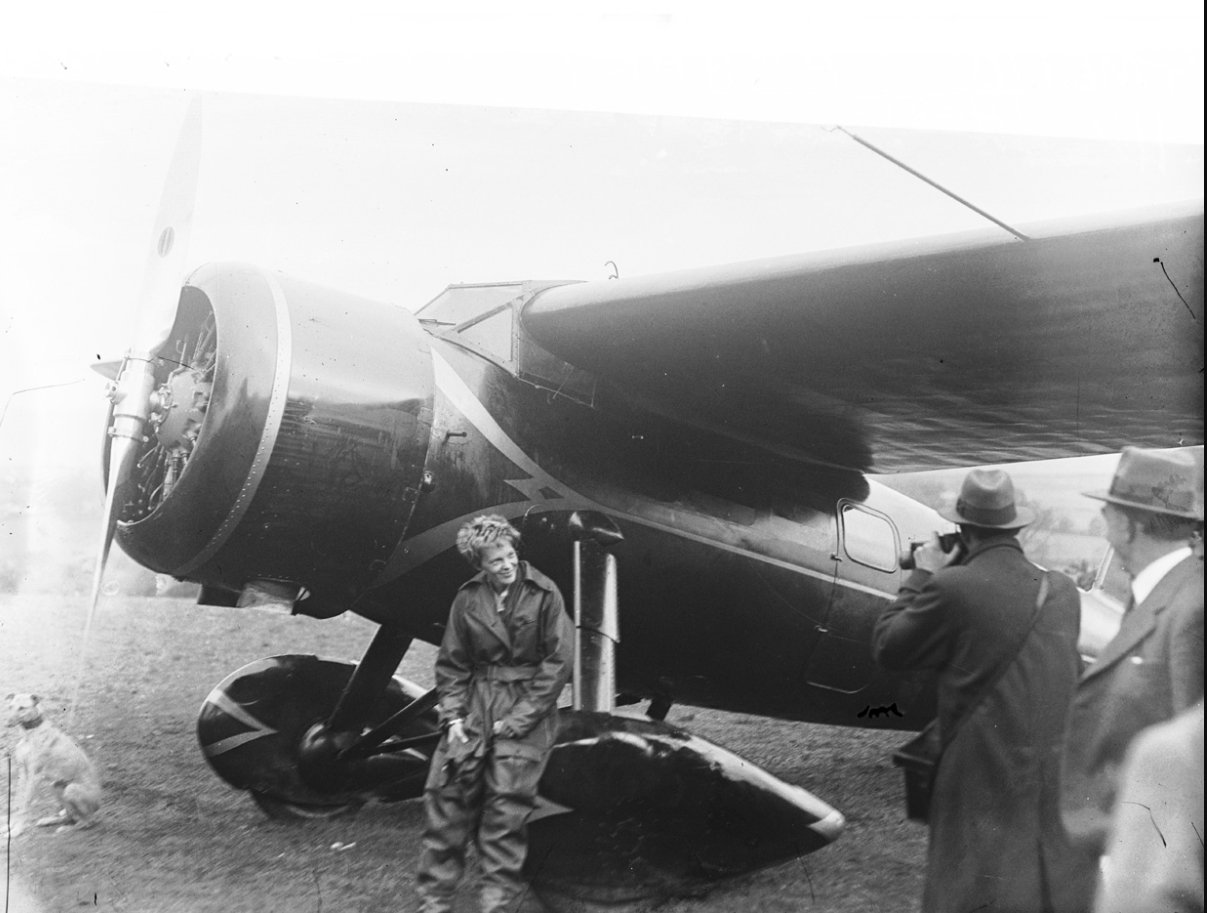

On 22nd May 1932 a slight, elfin-featured young woman with cropped hair arrived at RAF Aldergrove in Northern Ireland en-route for London. On that day she was probably the most famous woman in the world. Her name was Amelia Earhart. The previous day, she had completed the first female solo crossing of the Atlantic – from Harbour Grace, Newfoundland to a green pasture at Springfield Farm, in the townland of Shantallow, County Londonderry, in her single-engine Lockheed Vega 5B, NR-7952 – a distance of 2026 miles in a time of 14 hours and 54 minutes. It was an extremely hazardous journey, made much more difficult by icing on the flying surfaces, a broken altimeter, strong winds and poor visibility. At times she had to fly just 200 feet above the waves. At about the halfway point, a faulty exhaust pipe almost caused a fire and the petrol tank began to leak. She later wrote in her autobiography:
I flew for hours watching the flames from the engine manifold and wondering when the plane was going to blow up. All this time petrol was trickling down the back of my neck.
Near Londonderry, after scaring some of the cows in the neighbourhood, I pulled up in a farmer’s backyard. Three people came out to see who or what was in the airplane. I pushed the hatch back and stuck out my head. I wasn’t sure of the proper phrase for the occasion,
A commemorative article appeared in the Derry Journal written to mark the 70th anniversary describes what happened next:
Two local men, James McGeady and Dan McCallion were mending fences in fields close to their home at Shantallow. They became aware of a small red plane, an uncommon sight in those days, coming from the Moville direction. The plane began to circle. Suddenly the plane descended, so low that it clipped the hedgerow. The pilot regained control, circled McGeady’s house three times and landed uphill in the field not ten yards from where James and Dan were fencing, coming to a halt in front of two cottages owned by the McCallion and McLaughlin families.
James ran to the spot and approached the plane. For a while nothing happened, and then all of a sudden the pilot emerged unscathed. To his great surprise it was a woman! After asking McGeady to extinguish his cigarette as a precaution against a fuselage leak. McGeady, after recovering from his initial shock then asked, ‘Have ye come far?’ To which Earhart made the famous reply, ‘I’m from America.’
According to Amelia, ‘This remark made no impression whatever on the reception committee.’
Shortly after, she climbed out and walked to the nearby cottage owned by Hughie McLaughlin. One of the most detailed and eloquent eye-witness accounts of the landing was given to the BBC in 1935 by Mrs Isobel Gallagher, the wife of local farmer, Robert Gallagher:
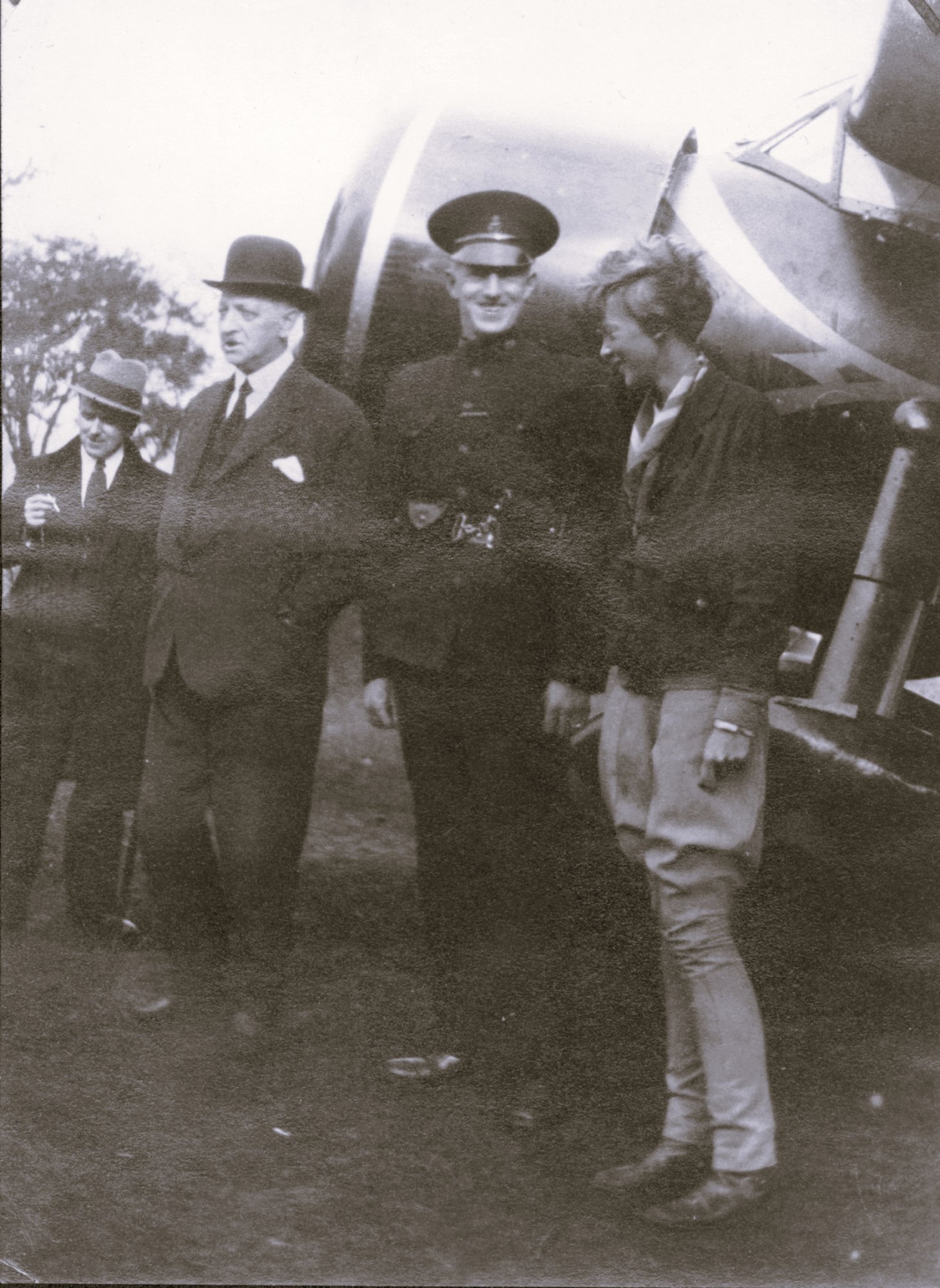
It was one of those lovely hot afternoons that you sometimes get in May and being a Saturday and the children not at school; we were sitting in the garden. Our place is at Culmore about two miles from Derry. We’ve a number of big fields around the house. Well, about two o’clock we heard an aeroplane and soon afterwards we saw a great red monoplane over the house, flying very low. It circled round a couple of times and then made for the big field at the back of the house and landed.
The afternoon was hot and I felt lazy, so, I’m afraid I didn’t pay much attention to it. I was too comfortable where I was. The children were very excited however. So, they and my husband went over to the field as did some of the farmhands and workers from other houses round about. My curiosity got the better of me. After a minute or two I went up to the plane as well. Standing beside it was a tousle-headed girl in trousers and a leather coat. She didn’t seem at all excited. The first thing she asked me for, after we had bidden her welcome, was a telephone. She would not wait to talk but went off with my husband as fast as she could over the fields to the nearest house on the land. She explained as she went that the only thing she wanted was to get through to her husband [the newspaper magnate, George Putnam, who Amelia had married a year earlier] and tell him she’d arrived safely.
There was no use in waiting, so I went back to the house. I suspected she’d be very hungry. So, I got a meal ready for her. She said she hadn’t had anything but tomato juice since she’d left America. We asked her to stay with us until she was ready to go on again and she said she would, so long as we didn’t mind her clothes. She had nothing but what she stood up in. in fact, she had literally no luggage of any kind with her whatever and no money either. But my husband was able to fix that.

The hospitable Gallaghers looked after Amelia, who was naturally concerned to let her husband, know that she was safe and had successfully completed her epic flight. News soon began to spread not just in the local area, where the police were soon made aware but across the Atlantic. After ‘cheerfully swallowing two cups of tea’ Amelia was taken by Robert Gallagher in his car to the main Post Office in Londonderry. Amelia was concerned that she had landed without means of paying, later writing, ‘Mr Gallagher assured me, however, that I had no occasion to worry about money as ‘we will see you through’.’ A telegram was sent to George Putnam, ‘Landed in pasture…Londonderry, Ireland…five miles from Londonderry…plane OK…8:35am Ireland.’
Back at the farm on Amelia’s return, Isobel Gallagher continued:
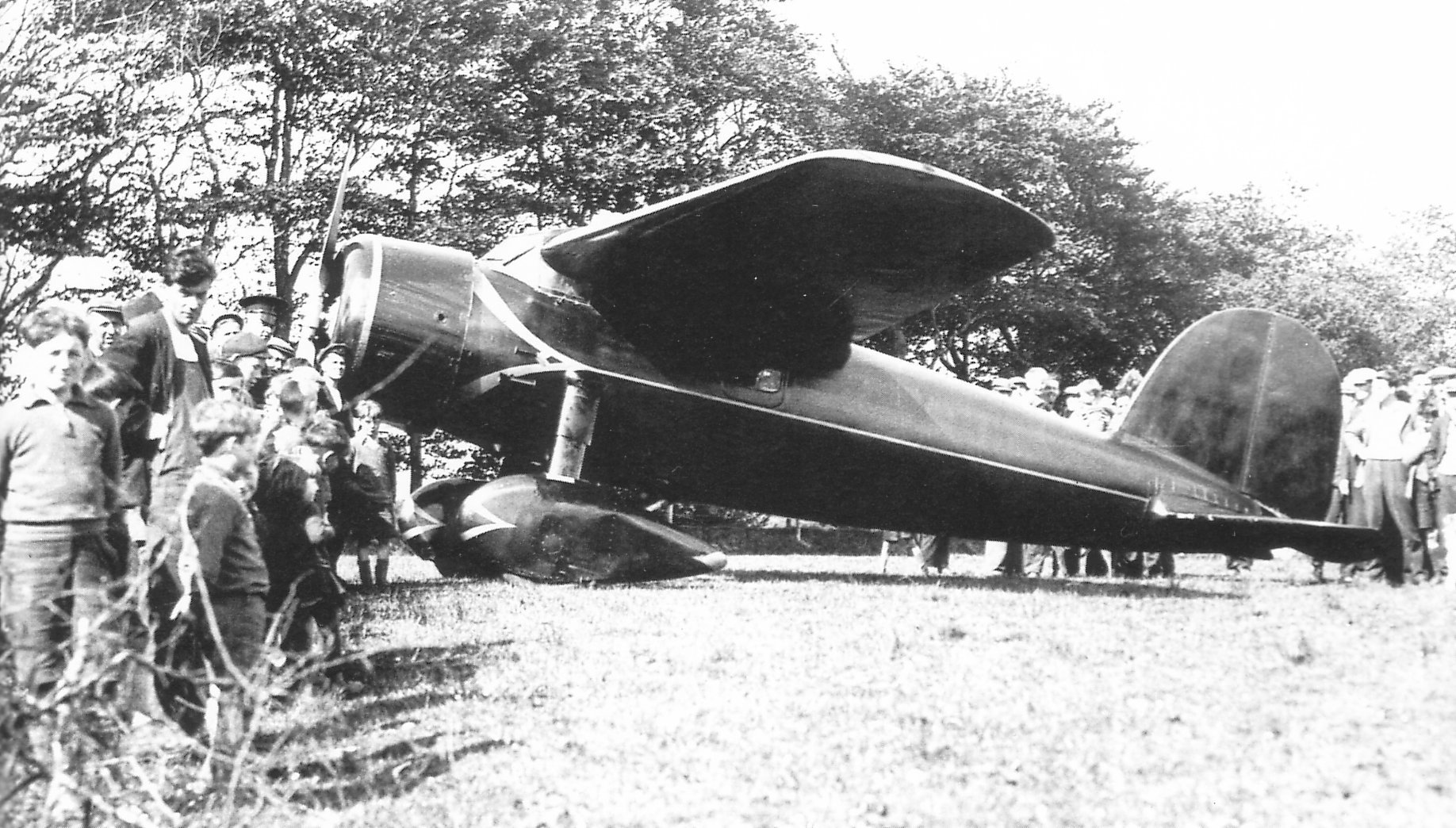
I lent her some nice things and life was just settling down again when the trouble really started. The news had got about that an American aeroplane had landed at our field and we were besieged by visitors, onlookers and of course, reporters. Poor Miss Earhart, she seemed to spend her whole time being interviewed and during the next day our place became a sort of a miniature aerodrome. There were no less than five press aeroplanes parked in one field at the same time. I spent most of the time making tea for all the people who came to call.
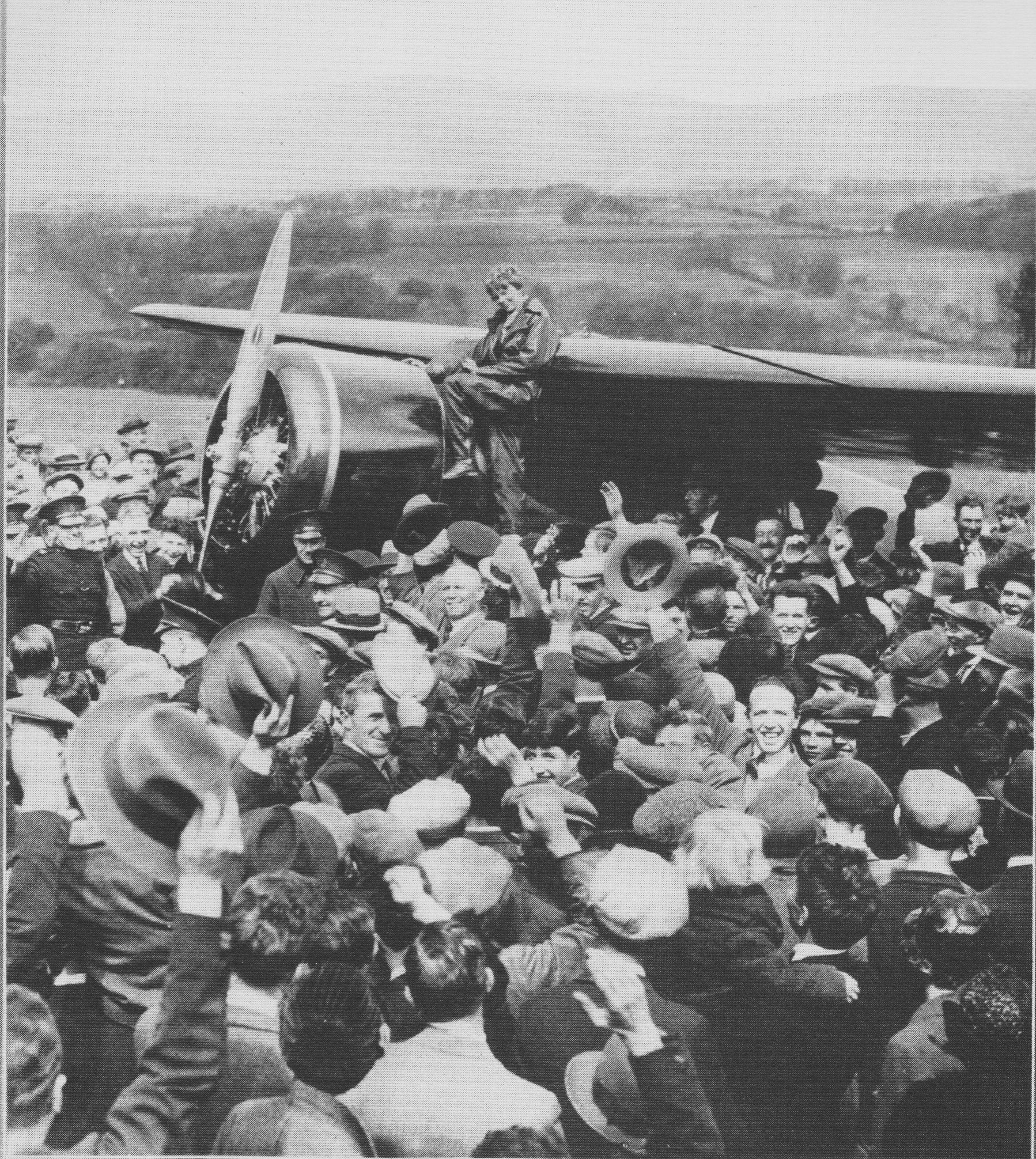
Among the crowd that followed her wherever she went was a woman who wanted to know why the flier risked her life to make the hazardous Atlantic crossing. Miss Earhart replied simply, ‘I did it for fun.’
Meanwhile, hundreds of messages flooded in to the Post Office from all over the world including one from President of the United States, Herbert Hoover:
I voice the pride of the nation in congratulating you most heartily upon achieving the splendid pioneer solo flight for a woman across the Atlantic Ocean. You have demonstrated not only your own dauntless courage, but also the capability of women to match the skill of men in carrying through the most difficult feats of high adventure.
Further messages came from Viscount Craigavon, the Prime Minister of Northern Ireland, who called to offer the hospitality of Stormont Castle. Lord Londonderry, the Secretary of State for Air, sent his congratulations. The renowned aviators, Amy Johnson and her husband, Jim Mollison, offered to fly her from Londonderry to Glasgow. The news had travelled fast that Amelia was inside the Post Office. Crowds began to fill the street, others stood on the old city walls, straining to see her, all cheering away. However, Amelia was keen to get back to the aeroplane which had served her so well and ensure that it was not being damaged by souvenir hunters. She made to make her way back towards Robert Gallagher’s car, with some difficulty, and in fact had to seek escape from the crowd in the nearby Northern Counties Hotel. The Derry Journal recorded, ‘It was a memorable scene, with the slender unassuming figure of the fearless flyer almost shyly facing a torrent of applause.’
After returning to the Gallagher’s house, Amelia was faced by a barrage of questions from members of the press who had arrived from London, Belfast, Dublin and Cork. This became very wearing, as she had not by this stage had any sleep for more than 36 hours. She asked them to put any further questions to the journalist, Cecil King, who was delighted to oblige, later remarking:
I didn’t bargain for all the monetary enticements I received to give them the story, but I was handsomely remunerated.
She had earlier telephoned Associated Press in London from the Post Office and booked a transatlantic call, returning to Derry in the evening to be connected:
Suddenly a voice came over the line, ‘New York calling. ‘From my husband’ Amelia exclaimed and grasped the receiver. Everyone left the room while Amelia spoke to her husband. ‘Hello this is Amelia speaking; I’ve done it, although I had to land here in the pastures outside Derry.’ She was able to tell him a little about her flight: she had chosen for the last hours to fly low over the ocean, she said, because ‘I’d rather drown than burn.’ The call lasted fifteen minutes before those outside heard a bright ‘cheerio’.
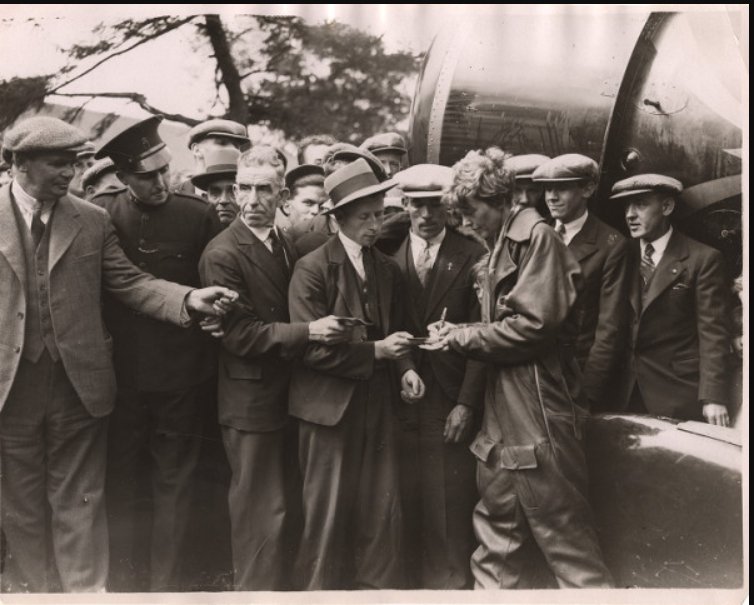
Amelia managed to get to bed at 11 o’clock but was up again by 6 o’clock on Sunday morning, ‘looking fresh and well-rested’. The scene that greeted her, in the field behind Gallagher’s house, was a throng of sightseers and five aeroplanes, which had been hired by the press. She had intended to fly her Lockheed Vega to Croydon. However, after taking advice concerning the strain already placed on the airframe and engine, she decided that it would be best for it to be dismantled and shipped back to the USA. Amelia asked Cecil King to witness the Vega’s barograph, the instrument that measured atmospheric pressure during the flight, being removed and to ensure that it was returned to New York for verification. After breakfast with the Gallaghers, Amelia was fully occupied by the demands of still and newsreel photographers and interviewers, posing by the cockpit wearing her leather flying suit.
Tragically, at 7 o’clock on the same Sunday morning a fatal accident took place. One of the aircraft hired to bring members of the press to Culmore, Desoutter II, G-ABFO, on its way to London ‘with photographs of Miss Earhart’, flew into a rocky, gorse-covered hillside, shrouded in fog, six miles south of Stranraer. The two men on board, the pilot, Major Irwin Napier Colin ‘Nobby’ Clarke DSC and Bar and Ernest Victor Barton, a press photographer lost their lives.
The Times described the scene graphically:
The pilot had lost his way in a dense fog which had enveloped the Irish Sea [North Channel] and the Scottish Coast. It was then heard backfiring loudly at a low altitude above some farm houses. The machine struck a knoll and somersaulted down the slope for 100 yards. The cabin was wrecked and the right wing smashed to splinters. The engine was thrown 40 yards into a burn and beside lay the body of Mr Barton. Twenty yards further on Major Clarke was found lying in a field, with his skull fractured, his legs broken and his boots torn off. He died within a few minutes.
Major Clarke, who was a director and chief pilot of Personal Flying Services Ltd, was born in Australia. He came to England at the outbreak of the war and went to the Dardanelles and later to France with a bombing squadron. He was awarded the DSC for ‘conspicuous good work’, earned a bar to the DFC and was several times mentioned in dispatches. He was a member of the Royal Aero Club.
Mr Barton was a member of the photographic staff of the Daily Sketch. He had recently returned from India, where he did special photographic work, after the return of Mr Ghandi, during the rioting near Bombay.
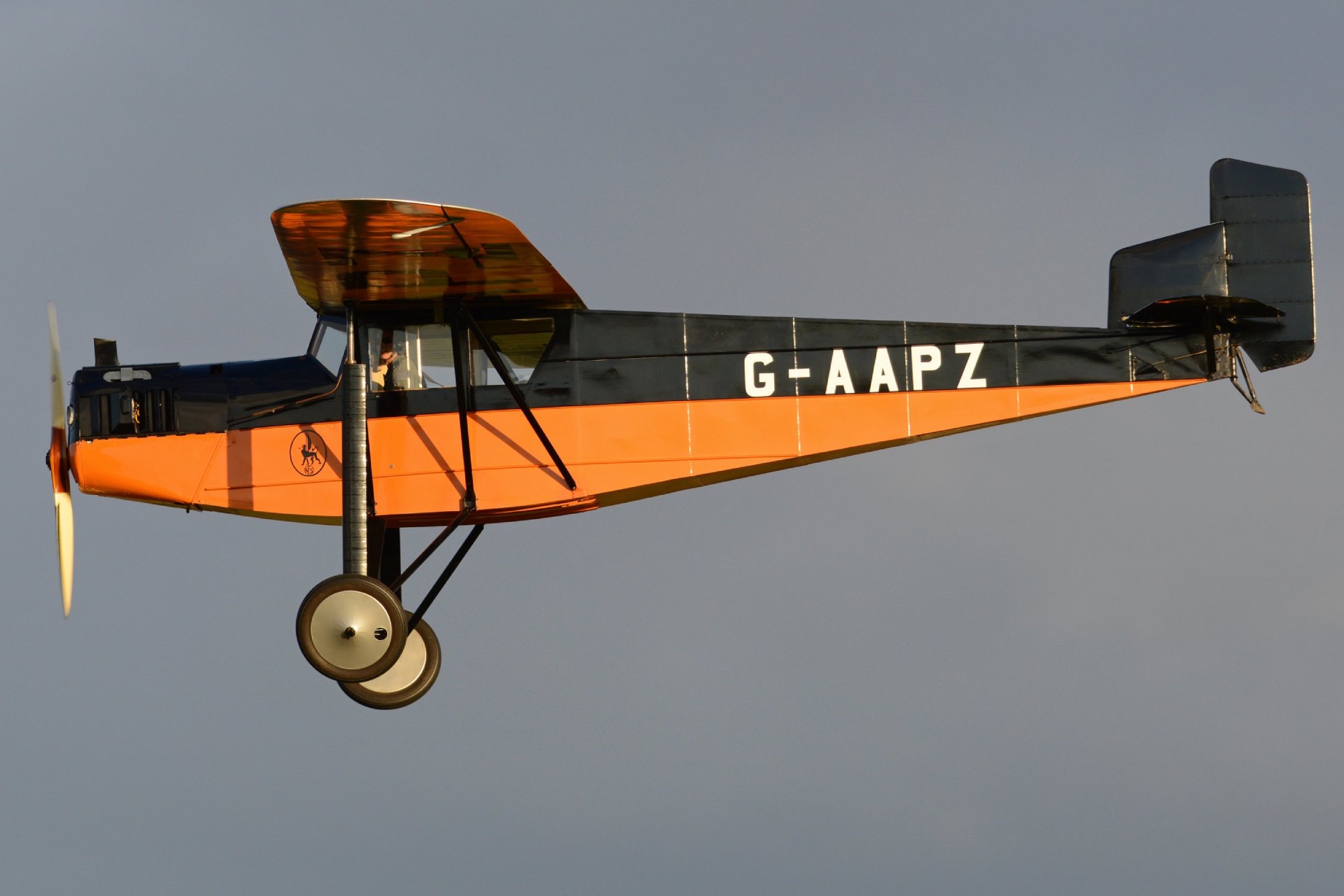
Back at Springfield Farm, at 9 o’clock that morning a Desoutter I cabin monoplane, G-AAPS, hired from National Flying Services by the Paramount Film Company, arrived to take Amelia on to London. In order to satisfy Paramount’s exclusive rights for any newsreel film, it was decided to postpone leaving until the afternoon to take sound pictures of the scene and of Amelia’s departure. The Mayor of Londonderry, Sir Dudley McCorkell, took this opportunity to call and ‘express the pleasure of the citizens at her triumph and add good wishes for a successful finish to her journey.’ Springfield Farm was next door to Ballyarnett which was the McCorkell family home. As could only be expected, the Desoutter’s take-off at a quarter to two was accompanied by ‘rousing cheers from the huge crowd’.
She reached London in a few hours, making stops at Aldergrove and Blackpool en-route, landing at ‘The London Air Park’ Hanworth in the early evening. She arrived to a downpour of rain with thunder and lightning and was greeted by the US Ambassador, Andrew W Mellon.
Naturally unaware of the crash in Scotland, Isobel Gallagher continued:
Well, our guest left us on the Sunday afternoon to go to England…We all liked her very much. There was no nonsense about her and we thoroughly enjoyed having our very unexpected guest. I can still hear her nice matter-of-fact voice saying about her flight as if it had been a rather long motor drive on a cold day.
When Amelia was later asked why she had done it she replied:
I just wanted to see if I could fly the Atlantic alone. We all fly Atlantics in our own way. If someone does something against tradition, neighbourhood opinion and so called ‘common sense’ that is an Atlantic…I flew the Atlantic because I wanted to…To want in one’s heart to do a thing, for its own sake; to enjoy doing it; to concentrate all one’s energies upon it – that is not only the surest guarantee of success. it is also being true to oneself.
Amelia Earhart sold her Lockheed Vega 5B to Philadelphia’s Franklin Institute in 1933 after purchasing a new Vega 5C. The Smithsonian acquired it in 1966.

The last word may be left to Foyle Golf Centre:
Today the spot of the landing mentioned as Gallagher’s pasture in Culmore is in fact, the 6th hole ‘Amelias Landing’ at Foyle Golf Club. The late Bert Gallagher [Robert and Isobel’s son] was privy to meeting Miss Earhart as a boy, and after passing down the family farm to the next generation, witnessed the transition in use to the present day Golf Centre where he is remembered at the 17th hole ‘Bert’s’. The story of Amelia’s landing and photographs are on display in Foyle Golf Centre for visitors to enjoy.
Grateful thanks are due to the Gallagher Family and David McCorkell for providing material from their Family Archives.

