


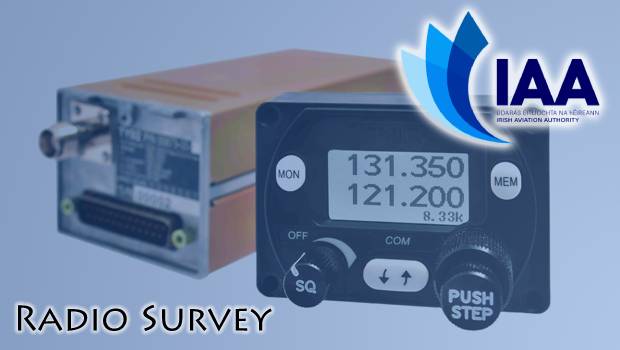
In early December the Irish Aviation Authority released the results of the Air-Ground Communications Survey that was conducted earlier in the year. The purpose of the survey was four-fold;
- To conduct a Regulatory Impact Assessment regarding the requirement for the allocation of 8.33 kHz channel spaced frequencies in Ireland;
- To assess the number of 8.33 kHz spacing capable radios in use in aircraft in Ireland;
- To assess the proliferation of portable Electronic Conspicuity (EC) devices in Ireland; and
- To better understand any communication difficulties in/near/below the Dublin CTA (FIS 118.5 MHz).
The results have been largely met with disappointment by the General Aviation community. To start with, an additional aim has been added to the results that was not communicated to the community at the time of the survey – that was to “To conduct a Regulatory Impact Assessment regarding the requirement for the allocation of 8.33 kHz channel spaced frequencies in Ireland”. Pilots were never informed that the information that was provided in this survey would be used to support the removal of an exemption for the use of 25kHz radios in General Aviation aircraft.
On the subject of 8.33kHz spacing, the results document makes three recommendations:
- It is recommended that the exemption to (EU) No 1079/2012 not be renewed
- It is recommended that the IAA promulgate information to the General Aviation community regarding the requirement to use an 8.33 kHz spacing capable radios after 31 Dec 2024.
- It is recommended that FIS frequencies remain on 127.5 MHz and 118.5 MHz.
This means that all aircraft must be fitted with an 8.33kHz radio by 31st December 2024 or it must be removed.
On the assessment of Electronic Conspicuity (EC) devices, the results document makes two recommendations which were:
- It is recommended that the IAA and ComReg establish a working group to analyse the introduction of portable EC devices into light aircraft in General Aviation in Ireland.
- It is recommended that the IAA consider implementing measures to encourage the use of EC devices in General Aviation in Ireland.
The final part of the results document addresses the reports of communication difficulties near and under the Dublin CTA. Leaving aside some of the condescending remarks made towards GA pilots in this section, the difficulties of many pilots do not appear to have been recognised by the IAA. It has been reported that in many instances the Dublin FIS controller could hear the pilot’s transmission but the pilot could not hear the response. Sources have suggested that this has also been raised by Air Traffic Controllers in Dublin who are unable to communicate with traffic in their area of responsibility despite having radar contact. (suggesting line of sight from the Dublin radar installations). This is contradicted by the report that states “Reports of Flight Information Service (FIS) difficulties with DUB FIS were all found to be related to attempted communications at locations or heights beyond the calculated area where line-of-sight VHF communications would be expected.”
One of the survey responses said: “DUB FIS often has difficulty hearing me or can’t hear me south abeam Kilcock heading 270 at 1000ft to 1500ft, Garmin 530 installed and in use. two-way comms often only established following a climb to 2000ft” – This distance is approximately 15nm and well within line of sight of Dublin Airport at 1000ft.
The adequacy of the positioning of the transmitter/receiver for 118.5 MHz does not appear to have been considered as part of this report.
The suggestion of assigning a Low-Level Common Frequency similar to the UK would be inappropriate for Ireland. This was established in the UK for aircraft not in receipt of an Air Traffic Service (ATS) or Lower Airspace Radar Service (LARS) and entering the UK Low Flying System. The UK Low Flying System is operated by the RAF and the equivalent exercises in Ireland by the Irish Air Corps are protected by Temporary Restricted Areas.
The three recommendations the report makes are:
- It is recommended that AirNav Ireland consider their handover procedures from Shannon Information to Dublin Information for aircraft at low level where the pilot may not be able to establish two-way communications with Dublin Information.
- It is recommended that the IAA and AirNav Ireland promulgate information on the technicalities of VHF radio functionality and FIS dependency.
- It is recommended that AirNav Ireland consider the appropriateness of assigning a Low Level Common Frequency in Ireland.
The survey results are available to read here.

